Ski size calculator
Enter your height, weight, ability and the terrain you ski most. You get a ski length range built from the sizing guides of Rossignol, Atomic, K2, Völkl, Line, Nordica, Head and evo, with the full chart below so you can see where each brand lands.
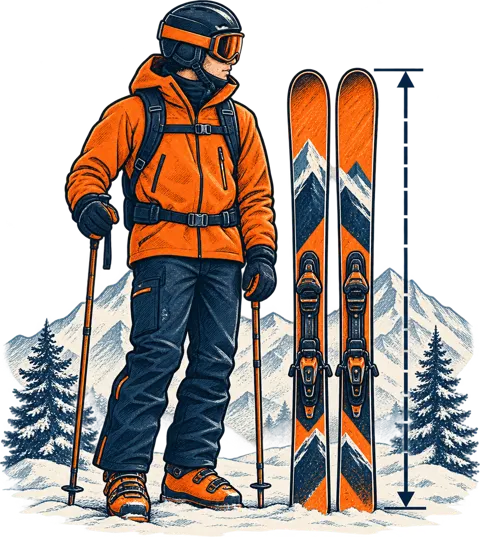
Short answer: Most ski makers put a beginner on skis about chin height, an intermediate between chin and nose, and an advanced skier at head height or longer. For a 5'8" (173 cm) intermediate skier that is 168 to 175 cm.
Every maker's number for you
Each maker's own chart for what you entered, side by side. Where they disagree, the result above is the overlap.
Fill in the calculator above to see each maker's own number.
Popular 2026/27 models in your size
The size each popular 2026/27 model comes in that is closest to your result, with a link to check prices.
Fill in the calculator above to see your size in each model.
Check the one you own
Enter the length of skis you already own to see whether they fit you for the terrain and level above.
Shop this size
Enter your details above to get shopping links for your ski length.
Affiliate links. We may earn a commission at no cost to you. See the disclosure.Ski size chart by height and ability Printable card (PDF)
Every brand uses the same picture: stood on end, your skis should reach between your chin and the top of your head. Beginners sit near the chin, experts at the head or above. The consensus columns blend evo's single values, the K2, Line and Völkl ranges (those three brands publish an identical chart) and Nordica's wide ranges.
| Height | cm | Beginner | Intermediate | Advanced / expert | evo (beg / int / exp) | K2, Line, Völkl (beg / int / adv) | Nordica |
|---|---|---|---|---|---|---|---|
| 4'4"–4'5" | 132–135 | 120–130 | 128–138 | 135–145 | 120 / 130 / 138 | — | 120–130 |
| 4'6"–4'7" | 137–140 | 125–135 | 133–142 | 140–150 | 125 / 135 / 143 | — | 125–135 |
| 4'8"–4'9" | 142–145 | 128–138 | 136–145 | 142–152 | 130 / 140 / 148 | 125–135 / 133–140 / 138–150 | 130–140 |
| 4'10"–4'11" | 147–150 | 133–143 | 141–150 | 147–157 | 135 / 145 / 153 | — | 135–145 |
| 5'0"–5'1" | 152–155 | 138–148 | 148–155 | 152–163 | 140 / 150 / 158 | 138–148 / 148–155 / 152–163 | 140–155 |
| 5'2"–5'3" | 158–160 | 143–153 | 152–160 | 158–168 | 145 / 155 / 163 | — | 145–165 |
| 5'4"–5'5" | 163–165 | 148–158 | 158–165 | 163–173 | 150 / 160 / 168 | 148–158 / 158–165 / 163–173 | 150–170 |
| 5'6"–5'7" | 168–170 | 153–163 | 163–170 | 168–178 | 155 / 165 / 173 | — | 155–175 |
| 5'8"–5'9" | 173–175 | 158–168 | 168–175 | 173–183 | 160 / 170 / 178 | 158–168 / 168–174 / 172–183 | 160–180 |
| 5'10"–5'11" | 178–180 | 163–173 | 173–180 | 178–188 | 165 / 175 / 183 | — | 165–185 |
| 6'0"–6'1" | 183–185 | 168–178 | 178–185 | 183–193 | 170 / 180 / 188 | 168–178 / 178–184 / 182–193 | 170–185 |
| 6'2"–6'3" | 188–190 | 172–182 | 182–189 | 187–196 | 175 / 185 / 190+ | — | 175–193 |
| 6'4" and up | 193+ | 174–184 | 184–190 | 188–198 | 180 / 190 / 190+ | 174–184 / 184–190 / 188–198 | 175–193 |
Where the brands differ: Rossignol's chart is the shortest, putting a piste-ski intermediate at height minus 7 cm and a beginner at minus 10; evo's expert column stops at "190+". K2, Line and Völkl split advanced skiers into "playful" (height minus 1 to plus 5) and "charger" (plus 3 to plus 10), which is where the top of the advanced column comes from.
Adjusting for weight and terrain
| Factor | Change | Who says so |
|---|---|---|
| Lighter than average for your height | 1–3 cm shorter | K2, Line, Völkl "size down 1–3 cm"; Nordica, evo, Head, REI "shorter"; Atomic up to 5–10 cm shorter for lighter or less experienced skiers |
| Heavier than average for your height | 1–3 cm longer | K2, Line, Völkl "size up 1–3 cm for added stability"; Atomic "up to 5 cm" |
| Groomers / carving | 2–5 cm shorter | K2 "subtract 2–5 cm"; Rossignol piste sizing about 5 cm shorter than all-mountain; Nordica "narrower carving skis with full camber can be skied shorter" |
| Powder / freeride | 2–5 cm longer | K2 "add 2–5 cm for flotation and stability"; Rossignol freeride at height to height plus 5 (expert); Nordica "size up skis with a lot of rocker" |
| Park / freestyle | 5–10 cm shorter | Rossignol freestyle: height minus 10 (beginner) to minus 5 (expert); Atomic "5 to 15 cm shorter"; K2 "subtract 2–5 cm" |
| Moguls / trees | 2–5 cm shorter | REI "quicker turns... trees or moguls"; evo "quick turns"; K2 "slower, controlled: subtract around 2 cm" |
| Fast, aggressive skiing | About 2 cm longer | K2, Line, Völkl |
| Lots of rocker | Longer | Nordica, K2 (no number) |
Rossignol's rule by ski type
Rossignol sizes relative to your height and by ski category, which is a useful second opinion. These are the figures from its dealer chart; its blog says the same in words.
| Ski type | Beginner | Intermediate | Advanced | Expert |
|---|---|---|---|---|
| Piste / carving | height − 10 | height − 7 | height − 5 | height |
| All-mountain | height − 10 | height − 5 | height | height + 5 |
| Freeride | height − 5 | height | height | height + 5 |
| Freestyle | height − 10 | height − 7 | height − 7 | height − 5 |
Kids' ski size chart
Kids' skis should reach between the child's chest and nose (evo, Nordica, Rossignol). Light or cautious children take the shorter end; heavier, faster or more advanced children the longer end. Nordica runs about 5 cm longer than evo at several ages and says not to go longer than the suggested range.
| Age | Height | Weight | Ski length | evo | Nordica |
|---|---|---|---|---|---|
| 3 | 3'1" / 94 cm | 34 lb / 14 kg | 70–80 | 70–80 | 70–80 |
| 4 | 3'4" / 102 cm | 37 lb / 16 kg | 80–90 | 80–90 | 80–90 |
| 5 | 3'7" / 109 cm | 42 lb / 18 kg | 90–100 | 90–100 | 90–100 |
| 6 | 3'9" / 114 cm | 46 lb / 21 kg | 95–110 | 95–105 | 100–110 |
| 7 | 3'11" / 119 cm | 50 lb / 23 kg | 100–110 | 100–110 | 100–110 |
| 8 | 4'2" / 127 cm | 57 lb / 26 kg | 110–120 | 110–120 | 110–120 |
| 9 | 4'5" / 135 cm | 63 lb / 29 kg | 115–130 | 115–125 | 120–130 |
| 10 | 4'7" / 140 cm | 70 lb / 32 kg | 120–130 | 120–130 | 120–130 |
| 11 | 4'9" / 145 cm | 79 lb / 36 kg | 130–140 | 130–140 | 130–140 |
| 12 | 4'11" / 149 cm | 89 lb / 41 kg | 135–150 | 135–145 | 140–150 |
| 13 | 5'2" / 157 cm | 100 lb / 46 kg | 140–150 | 140–150 | 140–150 |
| 14 | 5'5" / 164 cm | 112 lb / 51 kg | 150–160 | 150–160 | 150–160 |
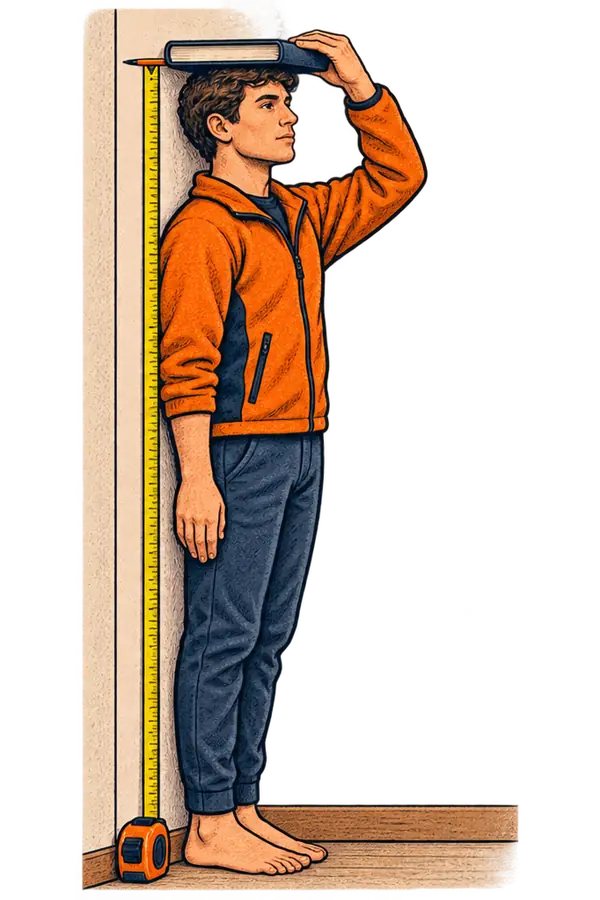
How to measure your height
How to check the fit
- Stand the ski on its tail next to you. Chin height is a beginner length, nose to forehead is intermediate, top of head or above is advanced (Atomic, K2, Nordica, Head, evo).
- Read the sidecut radius. Under 16 m turns short and suits carving; 17 to 22 m is all-mountain; over 22 m is for big mountain and powder (evo). A ski at the long end of your range with a short radius will still turn easily.
- Rocker lets you go longer. A rockered tip shortens the ski's effective edge, so wide all-mountain and powder skis are skied longer than a full-camber carving ski (Nordica, K2).
- When in doubt, go shorter. A ski that is a little short is easy to turn; one that is too long is tiring and scary. Beginners especially should take the short end.
Worked example
Hannah is 5'6" (168 cm), weighs 140 lb, skis black runs with confidence and spends most days on groomed trails. She is an advanced skier who carves.
Step 1: find her row in the height chart. 5'6"–5'7" (168–170 cm) shows 168–178 cm in the advanced column. evo prints a single 173 for an expert at this height, which sits inside that range.
Step 2: apply the terrain table. Groomers and carving means 2–5 cm shorter, so the span becomes roughly 163–176 cm. Rossignol's piste rule for an advanced skier is height minus 5, which is 163 cm, the bottom of that span.
Step 3: weight. She feels light for her height, so K2's 1–3 cm reduction applies, nudging the target toward 163–173.
That leaves a wide window, and the model she wants comes in 165 and 172. Both fit. Her two sources pull in different directions: the chart's top end and evo say 172, Rossignol's piste figure says 163 to 165. Because she carves rather than charges and wants quick edge changes, she takes the 165. If she were skiing the same trails faster and heavier, the 172 would be the better call. When two lengths both land inside the range, ability and speed decide it, and a skier who is unsure should take the shorter one.
More worked examples
Each example uses the numbers above and ends with a choice. Heights are converted at 2.54 cm to the inch.
Dan: 5'10", intermediate, mostly groomed runs
5'10" is 178 cm. K2's table has rows at 173 and 183 cm, and 178 sits halfway between them. Halfway between 168–174 and 178–184 is 173–179 cm. evo lists 175 for an intermediate at this height. Rossignol puts an intermediate on an all-mountain ski at 178 − 5 = 173 cm, and on a piste ski at 178 − 7 = 171 cm.
The sources overlap on 173 to 175. Dan skis groomers, and K2 says to subtract 2 to 5 cm for that, which would pull 175 down to somewhere between 170 and 173. He takes the lower half of the overlap: a ski between 171 and 175, whichever length the model comes in.
Priya: 5'4", beginner, on the light side
5'4" is 163 cm. K2 gives a beginner 148–158, evo gives 150, and Rossignol gives 163 − 10 = 153. The three centre around 150 to 153. Priya is lighter than average for her height, so K2's 1 to 3 cm reduction applies and her range tightens to about 148 to 153. Chin height on her is close to 150, which fits Atomic's "about chin height" for beginners. She should pick the ski that comes closest to 150 and not stretch to 158 on the theory that she will grow into it.
Tom: 6'2", advanced, wants a powder ski
6'2" is 188 cm, halfway between K2's 183 and 193 rows. The advanced playful range there is 185–191 and the charger range is 189–195. Rossignol's freeride expert is 188 + 5 = 193. evo shows "190+".
K2 adds 2 to 5 cm for powder, which would push a charger past 195. Tom skis tight trees as often as open bowls, so he reads himself as the playful column. Starting from 185–191 and adding 2 to 4 for the powder ski gives 187 to 195. The decision is the ski's profile. If it has a lot of rocker, K2 says to go longer, so he takes the top of that span. If it has traditional camber with a rockered tip only, he takes the lower end, around 190.
When you land between two lengths
Skis come in fixed lengths, so you will often be 2 or 3 cm from a size on both sides. Break the tie with the factors that point the same way:
| If you are | Take |
|---|---|
| A beginner, or skiing cautiously | The shorter size |
| Light for your height | The shorter size |
| Heavy for your height or skiing fast | The longer size |
| Skiing mostly powder or ungroomed snow | The longer size |
| On a heavily rockered ski | The longer size |
| On a full-camber carving ski | The shorter size |
When the factors disagree, ability wins. A ski that is slightly too short is easy to turn, while one that is too long wears out a skier who does not yet have the technique to drive it.
How this chart is built
We compared the published sizing guides from K2, Line and Völkl (identical tables), Nordica, Atomic, Rossignol, evo and Powder7. Where brands agree, the chart shows one range. Where they disagree, the chart shows the span that covers most of them rather than an average, because an average hides the real spread: Rossignol runs several centimetres shorter than evo at the same height, and a mean would match neither. The brand columns are printed beside the blended ones so you can see who says what.
The chart cannot know your technique, the stiffness or rocker of a particular ski, the snow where you ski, or how heavy you are for your height. Treat the result as a place to start in a shop, not a final answer. Head's and REI's guides could not be read in full on the last check, so their figures are not in the tables. Last checked October 2026.
Questions
What length skis do I need for my height?
Stood on end, skis should reach somewhere between your chin and the top of your head. Beginners sit near the chin (height minus 10 to 15 cm), intermediates between chin and nose (height minus 7 to plus 2 cm), and advanced skiers at head height or longer (height to height plus 10 cm). A 5'10" intermediate takes roughly 170 to 180 cm.
Does weight change ski length?
Yes, a little. K2, Line and Völkl say to size down 1 to 3 cm if you are lighter than average for your height and up 1 to 3 cm if heavier. Atomic allows up to 5 cm either way. Nordica, evo, Head and REI say the same without numbers.
Should powder skis be longer?
Yes. K2 says add 2 to 5 cm for powder and freeride, and Rossignol's freeride sizing runs about 5 cm longer than its all-mountain sizing. Park skis go the other way, 5 to 10 cm shorter than all-mountain.
Are women's skis sized differently?
No. The same chin-to-head rule applies. Women's models are built lighter and softer and usually come in shorter lengths, but the length you pick for your height and ability is the same.
Should my skis reach my chin or my nose?
It depends on ability. K2 puts beginners at chin height or shorter, intermediates between chin and nose, and advanced skiers at head height or above.
Related charts
 Ski boot size chartShoe size to Mondopoint
 Ski pole size chartPole length from height
 Snowboard size calculatorBoard length and width
 Ski sizes by brandOne skier, every maker's length
- K2 Ski Sizing Guide, Line Ski Sizing Guide and Völkl Ski Sizing Guide (height and ability table, terrain, weight and style adjustments)
- Nordica Ski Sizer (adult and kids tables, rocker guidance)
- Atomic, How to Choose the Right Alpine Ski
- Rossignol ski length chart as republished by its dealer Trojan Wintersports and the Rossignol article at Intersport Rent; Rossignol's own guide page loads the text by script
- evo, Ski Size Chart and Buying Guide and evo, Kids' Ski Size Chart
- Powder7 Ski Size Chart and Calculator (inputs and adjustment rules)
- Head's and REI's guides could not be read automatically on the check date; the chin-to-nose rule and lighter/heavier guidance attributed to them come from their search listings.
Added November 16, 2026 for the 2026/27 season (maker tables, model sizes, kids’ room to grow):
- Blizzard Ski Sizer (same chart as Nordica; kids: never longer than the suggested range)
- Faction, Skis Size Guide
- Icelantic, Ski Size Chart
- Stöckli, Ski Size Recommendation
- Head, How to Choose Your Ski Length
- evo's 2027 product pages (lengths for each 2026/27 model listed)