
Kids bike size chart and calculator
Enter your child's inseam, or height or age if you do not have it, to get the wheel size. The calculator lines up the 2026 charts of Trek, woom, Schwinn, Kent, Giant, Prevelo, Guardian and Specialized, wheel size by wheel size.
Short answer: Kids' bikes are sized by wheel, and inseam is the best guide. Most makers put a child with a 16 to 22 inch inseam (about ages 4 to 6) on 16-inch wheels and a 19 to 25 inch inseam (about ages 5 to 8) on 20-inch wheels; woom and Schwinn start each size about 3 to 4 inches of inseam higher.
Every maker's answer for your child
Each maker's own chart for what you entered, side by side. Where they disagree, the result above is the wheel size most of them share.
Fill in the calculator above to see each maker's own answer for your child.
Popular 2026 kids' bikes in your child's size
The size of each popular model that fits your child, from that maker's own range, with a link to check prices.
Fill in the calculator above to see the size that fits your child in each popular model.
Check the bike you have
Enter the wheel size of your child's current bike to see whether it still fits for the inseam or height above.
Shop this size
Enter your child's inseam or height above to get shopping links for the wheel size.
Affiliate links. We may earn a commission at no cost to you. See the disclosure.Kids bike size chart by wheel size Printable card (PDF)
Inseam is the most reliable measurement; age and height overlap a lot between wheel sizes. Academy's chart has no 18 inch row, so those figures come from BikeRadar only. BikeRadar's figures are the minimum inseam for each wheel size.
| Wheel size | Academy: age | Academy: height | Academy: inseam | BikeRadar: age | BikeRadar: minimum inseam |
|---|---|---|---|---|---|
| 12" | 2–3 | 36"–39" | 13"–17" | 2+ | 12" (30 cm) |
| 14" | 3–5 | 37"–44" | 15"–20" | 3+ | 15" (38 cm) |
| 16" | 4–6 | 41"–48" | 16"–22" | 4+ | 16" (41 cm) |
| 18" | — | — | — | 5+ | 18" (46 cm) |
| 20" | 5–8 | 45"–54" | 19"–25" | 6+ | 20" (51 cm) |
| 24" | 8–11 | 49"–59" | 23"–28" | 8+ | 23" (58 cm) |
| 26" | 10–12+ | 56"+ | 25"+ | 10+ | 25" (64 cm) |
The two sources are not identical: Academy's 16 inch row allows an inseam from 16 to 22 inches, while BikeRadar's 16 inch minimum is 16. If the inseam sits in an overlap, pick the size where your child can put the balls of both feet on the ground comfortably, and have them sit on the bike before you buy.
Inseam in inches by wheel size, maker by maker
The same child can land on different wheel sizes depending on the brand. Each column is that maker's own inseam range in inches, checked November 16, 2026; the last column is the middle of the charts that give a range (Trek, woom, Schwinn, Kent, Giant, Prevelo and Academy). Balance bikes are marked and left out of that column.
| Wheel | Trek | woom | Schwinn | Kent | Giant / Liv | Prevelo | Most makers |
|---|---|---|---|---|---|---|---|
| 12″ | 15–18 | 10–14.4 GO 1, balance | 16–19 | 15–18 | 14–20 | 12.5–16.5 balance | 15–18 |
| 14″ | — | 16–19.1 GO 2 | — | 15–20 | — | 14–17.5 Alpha One | 15–19.5 |
| 16″ | 16–22 | 19.1–25.2 GO 3 | 19–22 | 16–22 | 19–23 | 15.5–22 Alpha Two | 16–22 |
| 18″ | — | — | 21–25 | 18–24 | — | — | 19.5–24.5 |
| 20″ | 19–25 | 22.1–27.9 GO 4 | 23–27 | 19–25 | 22–25 | 19–23 Alpha Three | 19–25 |
| 24″ | 23–28 | 26.4–32.3 EXPLORE 5 | by height | 23–28 | 24–28 | 23–28 Alpha Four | 23–28 |
| 26″ | 25+ | 29.5–37.4 EXPLORE 6 | from 4′6″ tall | 25–30 | 26–32 | 25–30 Alpha Five | 25–31 |
Guardian and Specialized size by height only (Guardian 16″ at 40–46″ tall, 20″ Small at 43–51″, 20″ Large at 45–53″, 24″ at 49–57″; Specialized Jett 16 at 3′1″–3′11″, Jett 20 at 3′4″–4′3″, Jett 24 at 3′6″–4′10″), and Retrospec and Cannondale publish age bands. Their answers are in the maker table under the calculator.
How to check the fit
- Measure the inseam. Riding shoes on, a book between the legs against the groin, floor to book top, three times.
- Check standover. The child's inseam should be at least equal to the bike's standover height; a bit more clearance is more comfortable (Academy).
- Seat height depends on the stage. Academy suggests about 1 inch above inseam on a balance bike, 0 to 3 inches above on a bike with training wheels, level with the inseam on a big-kid bike (feet flat when stopped), and 2 to 4 inches above for experienced riders on tiptoes.
- Do not oversize. BikeRadar warns that a bike that is too big makes a child nervous and harder to control; some brands offer trade-up schemes as the child grows.
Worked example
Leo is 7, with a 22 inch inseam measured in his riding shoes. In the maker table, all seven charts that size by inseam include 22 inches in their 16 inch range, but for Trek, Schwinn, Kent, Prevelo and Academy that is the very top of it. Trek, Kent, Giant, Prevelo and Academy also put 22 inches in their 20 inch range, and woom's GO 4 (20 inch) starts at 22.1 inches, a tenth of an inch away.
So the calculator answers 20 inch wheels: the 16 inch fits today, but Leo is about to outgrow it, and the 20 inch leaves about 3 inches of inseam to grow on most charts. Schwinn is the exception: its 20 inch starts at 23 inches, and its 18 inch (21–25) fits him now. Either way, have him sit on the bike: with the seat at its lowest he should reach the ground with both feet.
Why kids bikes use wheel size
Trek's kids buying guide says children's bikes are sized by wheel diameter, not frame size, in a range from 12 to 26 inches. Adult bikes are the other way round: they come in frame sizes, and Trek says a child of 13 or so often fits the smallest adult bikes. BikeRadar notes that kids bikes are sold by age or by wheel size depending on the brand, which is why one shop's "6 year old bike" is another shop's 18 inch.
All three sources warn that age is a weak guide because children grow at different rates. Trek says its age brackets tend to overlap and recommends a test ride at a local shop. Academy puts it bluntly: inseam is the most important factor for choosing wheel size.
Measuring inseam for a bike
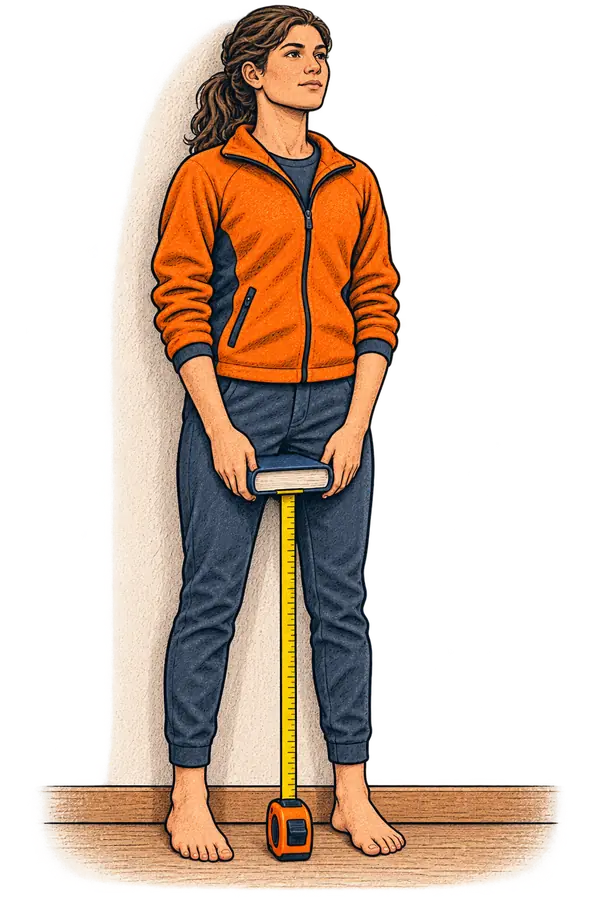
Academy's method: have the child stand against a wall in their riding shoes, put a book or ruler between their legs snug against the groin, and measure from the ground to the top of the book. Do it three times. Wear the shoes the child will actually ride in.
Compare the number to the inseam ranges above, then check that the child can swing a leg over the bike easily. Another retailer, Tweeks Cycles, measures barefoot and calls inseam the most accurate way to pick a size, with height as a secondary check. Its published table puts the 14 inch wheel at an inseam of 35 to 45 cm, a little lower than the others, which shows how much the sources disagree at the edges.
Standover and seat height
Standover height is the distance from the ground to the frame tube between the child's legs. Academy says the child's inseam should be at least equal to the bike's standover height. Trek asks for about one to two inches between the child and the top tube when they stand over the bike with their feet on the ground. REI, in its mountain bike fit advice for kids, suggests 2 to 4 inches of standover clearance.
Seat height changes with what the child is riding. Academy's guidance:
- Balance bike: about 1 inch above the inseam.
- Bike with training wheels: 0 to 3 inches above the inseam.
- Big-kid bike without training wheels: level with the inseam, so the feet are flat on the ground when stopped.
- Experienced rider: 2 to 4 inches above the inseam, on tiptoes at a stop.
Trek adds that beginners need more bend in the knees, and that you should raise the seat toward full leg extension as they get comfortable pedalling.
Balance bikes and training wheels
Academy recommends balance bikes for roughly ages 2 to 4 and says they build balance and coordination before a pedal bike. Both Academy and BikeRadar put them on 12 inch wheels; BikeRadar's minimum inseam is about 12 inches. Trek says the child's feet should be flat on the ground when seated, since they push the bike along with them, and that balance bikes typically have no brakes or a coaster brake.
Trek's note on training wheels: they suit children who are too big for a balance bike or need more time to build confidence. With them fitted, only the toes should touch the ground when seated. Trek says the emphasis should be on balance, not pedalling, and that the training wheels should come off once the child is comfortable.
Growing into a bike: the sources disagree
Academy takes the generous view. It says to pick a bike that fits now and has room to grow, notes that seats usually adjust so wheel size matters most, and says that a child who falls between sizes can take the bigger wheel if they can still reach the ground with their toes. It suggests adjustable seat posts and removable training wheels for budgets that have to last.
BikeRadar says the opposite. Buying a size up so the child grows into it is tempting, but "that's not optimal": an oversized bike can make a child nervous, cost them confidence and make it easier to overbalance and fall. Trek agrees, saying a bike that is too big can slow learning and hurt confidence. Both mention trade-up programmes, where the shop discounts a larger bike when the child outgrows the first one.
One workable reading of the three: the "grow-into" allowance in Academy's advice is a matter of a few inches of inseam at a boundary, not a whole wheel size. Tweeks makes a related point for 12 to 20 inch wheels, saying the bottom of the inseam range matches the wheel size. A child with a 14 inch inseam suits the 14 inch bike. Matching the nearest wheel size leaves some room without putting the child on a bike they cannot control.
Another worked example
A 6 year old is 44 inches tall with a 20 inch inseam in shoes.
- Academy: 16 inch covers inseams to 22 and heights 41 to 48 inches. 20 inch starts at an inseam of 19 but a height of 45 inches. She fits both on inseam, and her height lands in the 16 inch band.
- BikeRadar: the minimum inseam for a 20 inch wheel is 20 inches, and for an 18 inch is 18 inches. She is at the 20 inch minimum exactly.
- Trek: 4 to 6 years suggests 16 inch; 5 to 8 suggests 20 inch.
She is on the boundary. Put her on both bikes. If she can swing a leg over the 20 inch, plant the balls of both feet with the seat lowered, and reach the brake levers, buy it. If she is on tiptoe or cannot start from a stop easily, the 18 inch (where one is made) or the 16 inch is the safer bike. Her age says nothing the inseam has not already said.
Moving up to adult sizing is covered in the frame size guide, and a helmet that fits matters at every stage: see the bike helmet fit guide.
How this chart is built
The calculator reads the size charts that eight makers publish for their own kids' bikes (Trek, woom, Schwinn, Kent, Giant and Liv, Prevelo, Guardian and Specialized), two that give age bands only (Retrospec and Cannondale), and two references (Academy Sports + Outdoors and BikeRadar). Every number is copied from the maker's page as it read on November 16, 2026; nothing is averaged into a new chart except the "most makers" column, which is the middle of the published ranges.
Inseam comes first because it is what every maker that gives it calls the best guide; height is used when there is no inseam, and age only when there is neither. The result is the wheel size that most charts using that measurement include. When two sizes tie, a confident rider gets the larger one and a child who is still learning the one whose ranges they sit nearest the middle of. A child at the very top of most ranges for a size moves up when the next size fits all but one of those charts. A confident rider also moves up once at least half the charts already include them, following Cannondale's rule that a confident rider needs only the balls of both feet on the ground; a learner keeps the size that fits today, as Trek and Giant advise. Below about a 14.5 inch inseam (or about 3 feet tall) the answer is a balance bike, and past most makers' 26 inch ranges it is a small adult frame. Room to grow is measured to the top of the makers' ranges for that size. The charts cannot know how tall a seat post goes, how heavy the bike is or how confident your child is, so check the bike's listed seat height and have your child sit on it before you buy.
Questions
What size bike does a 5 year old need?
Age is the weakest guide. Around age 5 the makers' charts list 14, 16, 18 and 20 inch wheels: Kent puts 5 year olds on 14, 16 or 18 inch bikes, Trek on 16 or 20 inch, and Schwinn on 12 or 16 inch. Measure your child's inseam and use the calculator: inseam decides the wheel size, not age.
Should I buy a bigger bike so my child can grow into it?
Most makers say no. Trek says not to size up thinking they will grow into it, Giant says to choose a bike that fits today, and BikeRadar warns that an oversized bike makes a child nervous and easier to overbalance. Academy is the exception: it says a child between sizes can take the larger wheel if they can still reach the ground with their toes. Cannondale splits the difference: the smaller size for a beginner, the larger for a confident rider. A bike bought at the bottom of its range lasts about two years, woom says.
How do I measure a child's inseam for a bike?
Have the child wear their riding shoes, place a book between their legs against the groin, and measure from the floor to the top of the book. Repeat three times (Academy).
What is standover height?
It is the height of the bike's top tube or frame where the child stands over it. Academy says the child's inseam should be at least equal to the bike's standover height, and more clearance is more comfortable.
What size is a balance bike?
Both Academy and BikeRadar put balance bikes at 12 inch wheels, for about ages 2 and up, with a minimum inseam of about 12 inches.
What size bike does a 4 year old need?
Academy lists 14 inch wheels (ages 3 to 5) and 16 inch (ages 4 to 6) for a 4 year old. BikeRadar starts 16 inch bikes at an inseam of 16 inches. Measure the inseam and use that.
Is a 20 inch bike too big for a 5 year old?
Academy puts 20 inch wheels at ages 5 to 8 and an inseam of 19 inches or more. BikeRadar's minimum is a 20 inch inseam and age 6 or older. A 5 year old with an inseam under 19 inches is too small for the 20 inch.
What should the seat height be?
It depends on the stage. For a big-kid bike without training wheels, Academy says level with the inseam so the feet are flat when stopped. Experienced riders can have it 2 to 4 inches above.
When does a child move to an adult bike?
Trek says that above 12 years or about 4'8" you can start looking at adult bikes, which are sold by frame size rather than wheel size. BikeRadar's 26 inch minimums are a 25 inch inseam and a height of 4'7".
Related charts
Bike size chartAdult road, gravel and mountain frame size
 Bike helmet size chartHelmet size from head circumference
All bike sizingAdult and kids bike charts
- Trek, Kids Bike Buyer's Guide by Age & Size
- woom, What Size is Right? (inseam chart, size overlap, sizing up)
- Schwinn, Guide to Kids' Bike Sizes
- Kent, Find Your Perfect Fit (sizing for kids and teens)
- Liv (Giant), How to Buy a Bike for Your Child
- Giant, STP youth bike sizing guide
- Prevelo model pages: Alpha Zero, Alpha One, Two, Three, Four, Five, Zulu Three, Four and Five
- Guardian bike pages: 16 inch, 20 inch Small, 20 inch Large and 24 inch
- Specialized support: Jett fit and Riprock fit
- Retrospec, Kids Bikes Size Guide for All Ages
- Cannondale, Kids Bike Buying Guide
- Academy Sports + Outdoors, Kids Bike Size Chart
- BikeRadar, The ultimate guide to bike sizes (kids table)
- Tweeks Cycles, How to Measure Bike Size for Your Child
- REI, Mountain Bike Fitting Basics