Ski pole size chart
Enter your height and get your alpine pole length in inches and centimetres, plus cross-country classic and skate lengths. The chart below shows what evo, Fischer, Leki, Salomon, Rossignol, Swix and Black Diamond each recommend.
Short answer: Alpine ski poles run about 0.7 times your height: a 5'7" to 5'9" skier takes 120 cm (48 in) poles. Turned upside down and gripped under the basket, the right pole puts your elbow at about 90 degrees.
Every maker's number for you
Each maker's own chart for what you entered, side by side. Where they disagree, the result above is the overlap.
Fill in the calculator above to see each maker's own number.
Check the one you own
Enter the length of poles you already own (printed near the grip) to see whether they fit the type above.
Shop this size
Enter your height above to get shopping links for your pole length.
Affiliate links. We may earn a commission at no cost to you. See the disclosure.Alpine ski pole size chart Printable card (PDF)
Alpine poles are sized in 5 cm steps. Nearly every brand lands on the same answer: about 70% of your height. The consensus column is what evo, Powder7, K2, Fischer, Leki, Salomon and Rossignol agree on. Black Diamond uses coarser 10 cm steps and Swix gives a 5 cm range and says to take the shorter one.
| Your height | cm | Pole length | inches | Fischer (height × 0.7) | Leki / Salomon | Rossignol | Swix | Black Diamond |
|---|---|---|---|---|---|---|---|---|
| under 3'5" | under 105 | 80 cm | 32 in | 70–75 | — | 70–75 | — | — |
| 3'5"–3'8" | 105–114 | 85 cm | 34 in | 75–80 | — | 75–80 | — | — |
| 3'9"–4'0" | 115–124 | 90 cm | 36 in | 80–85 | 85 | 80–85 | — | — |
| 4'1"–4'4" | 125–134 | 95 cm | 38 in | 85–90 | 90 | 90 | — | — |
| 4'5"–4'8" | 135–144 | 100 cm | 40 in | 95–100 | 95–100 | 95–100 | — | — |
| 4'9"–5'0" | 145–154 | 105 cm | 42 in | 100–105 | 100–105 | 100–105 | 90–100 (150) | 100 |
| 5'1"–5'3" | 155–161 | 110 cm | 44 in | 110 | 110 | 110 | 100–110 | 110 |
| 5'4"–5'6" | 162–169 | 115 cm | 46 in | 115 | 115 | 115 | 110–115 | 110 |
| 5'7"–5'9" | 170–176 | 120 cm | 48 in | 120 | 120 | 120 | 115–125 | 110–120 |
| 5'10"–6'0" | 177–184 | 125 cm | 50 in | 125 | 125 | 125 | 120–130 | 120–130 |
| 6'1"–6'3" | 185–191 | 130 cm | 52 in | 130 | 130–135 | 130–135 | 130–135 | 130 |
| 6'4"–6'6" | 192–199 | 135 cm | 54 in | 135 | 135 | 135 | 135 | 130 |
| 6'7" and up | 200+ | 140 cm | 56 in | 140 | 140 | 140 | 135 | 130 |
Where the brands differ: Vermont Ski & Sport's chart runs one size (5 cm) shorter than the consensus throughout. Swix says that if you fall between two lengths "take the shortest option." evo prints 125 cm as 49 inches; everyone else prints 50.
Adjusting for how you ski
| You ski | Change | Who says so |
|---|---|---|
| All-mountain / groomers | Chart length | All sources |
| Park / freestyle | Shorter, 5–10 cm or more; some ride 100 cm poles or none | evo "shorter to avoid interference when skiing switch"; Powder7 "even shorter poles (or no poles at all)"; Fischer "1-meter poles as standard" |
| Freeride / powder | About 5 cm shorter, or chart length with powder baskets | Fischer "subtract approx. 5 cm"; evo and Powder7 recommend larger baskets rather than a length change |
| Backcountry touring | Adjustable pole covering the chart length: longer for climbing, shorter for descents | evo, Fischer, Powder7, Leki |
| Racing | Slalom shorter; giant slalom about 5 cm longer than slalom; speed events longest | The Race Place |
| Kids | Same chart; an adjustable pole covers a few seasons of growth | evo, Fischer |
Cross-country ski pole size chart
Nordic poles are much longer than alpine poles and come in two lengths for the two techniques. Classic poles reach your armpit or shoulder, about 83 to 85% of your height. Skate poles reach between your chin and nose, about 88 to 90% of your height. The racing rule (FIS) caps classic poles at 83% of height measured in ski boots. Rossignol, evo and Swix broadly agree; Swix's skate lengths run about 2.5 cm longer and its classic lengths a little shorter.
| Your height | cm | Classic pole | Skate pole | Rossignol classic / skate | evo classic / skate | Swix classic / skate |
|---|---|---|---|---|---|---|
| 3'11" | 120 | 90–100 cm | 100–105 cm | 90 / 100 | 90–95 / 100–105 | — |
| 4'3" | 130 | 100–105 cm | 110–115 cm | 100 / 110 | 100–105 / 110–115 | — |
| 4'7" | 140 | 110 cm | 120 cm | 110 / 120 | 110 / 120 | — |
| 4'11" | 150 | 120–125 cm | 130–135 cm | 120 / 130 | 125 / 135 | 115–117.5 / 127.5–130 |
| 5'1" | 155 | 125–130 cm | 135–140 cm | 125 / 135 | 130 / 140 | 120 / 132.5 |
| 5'3" | 160 | 130–135 cm | 140–145 cm | 130 / 140 | 135 / 145 | 125 / 137.5 |
| 5'5" | 165 | 135–140 cm | 145–150 cm | 135 / 145 | 140 / 150 | 130 / 142.5 |
| 5'7" | 170 | 140–145 cm | 150–155 cm | 140 / 150 | 145 / 155 | 135 / 147.5 |
| 5'9" | 175 | 145–150 cm | 155–160 cm | 145 / 155 | 150 / 160 | 140 / 152.5 |
| 5'11" | 180 | 150–155 cm | 160–165 cm | 150 / 160 | 155 / 165 | 145 / 157.5 |
| 6'1" | 185 | 155–160 cm | 165–170 cm | 155 / 165 | 160 / 170 | 150 / 162.5 |
| 6'3" | 190 | 160–165 cm | 170–175 cm | 160 / 170 | 165 / 175 | 155 / 167.5 |
| 6'5" | 195 | 165–170 cm | 175–180 cm | 165 / 175 | 170 / 180 | 160 / 172.5 |
| 6'7" | 200 | 170 cm | 180 cm | 170 / 180 | 170 / 180 | 165 / 177.5 |
Formulas published by the brands: Fischer classic = height × 0.84, skate = height × 0.89. Salomon classic = height × 0.83, skate = height × 0.89. Swix: classic = height minus 35 cm, skate = height minus 22.5 cm, with height measured in ski boots and poles measured to the strap exit. Swix also says to take the shorter pole when you are between sizes.
How to check the fit
- Alpine: the upside-down test. Flip the pole, put the grip on the floor and hold it just under the basket. With your upper arm at your side, your elbow should bend to about 90 degrees and your forearm should be level (evo, Powder7, Fischer, Scott, Black Diamond). If your forearm points up, the pole is too long.
- Alpine: the measuring tape. Stand in your ski boots, bend your elbow to 90 degrees and measure from the floor to the top of your hand. Swix uses that number directly; Salomon adds 10 cm and evo adds about 2 inches for the tip sinking into snow.
- Classic cross-country. Standing on the floor in shoes, the grip top (or strap exit) should reach your armpit to shoulder, or the middle of your collarbone.
- Skate cross-country. The grip should reach between your lower lip and your nose.
- In doubt, go shorter. A slightly short pole costs nothing; a long one throws your weight back.
Worked example
Priya is 5'8" (173 cm) and wants one pair of poles for resort skiing and another for classic cross-country. For alpine, the chart puts 5'7"–5'9" at 120 cm. Fischer's formula (height × 0.7) gives 121 cm, so 120 is right and nothing needs deciding.
The cross-country side is where it gets interesting. In the table, 173 cm sits between the 170 cm row (classic 140–145) and the 175 cm row (classic 145–150). The published formulas spread out: Fischer's × 0.84 gives 145.3 cm, Salomon's × 0.83 gives 143.6, and Swix's height minus 35 gives 138 (measured in ski boots, which adds a few centimetres to her height and narrows that gap). So the sources span about 138 to 145.
How to choose: she is a recreational skier, and Swix says to take the shorter option when between two lengths, so she starts at 140. The grip should reach her armpit when she stands in shoes with the tip on the floor. If she double-poles a lot and 140 feels stubby, 145 is fine, which is the top of the shoulder-to-armpit range. For skating, the same rows give 150–155 from the chart and 154 from Fischer's × 0.89, so 150 or 155 both work. Skating poles are not capped by a race rule at her level, and a pole that reaches the lower lip to nose is correct.
Three ways to measure for alpine
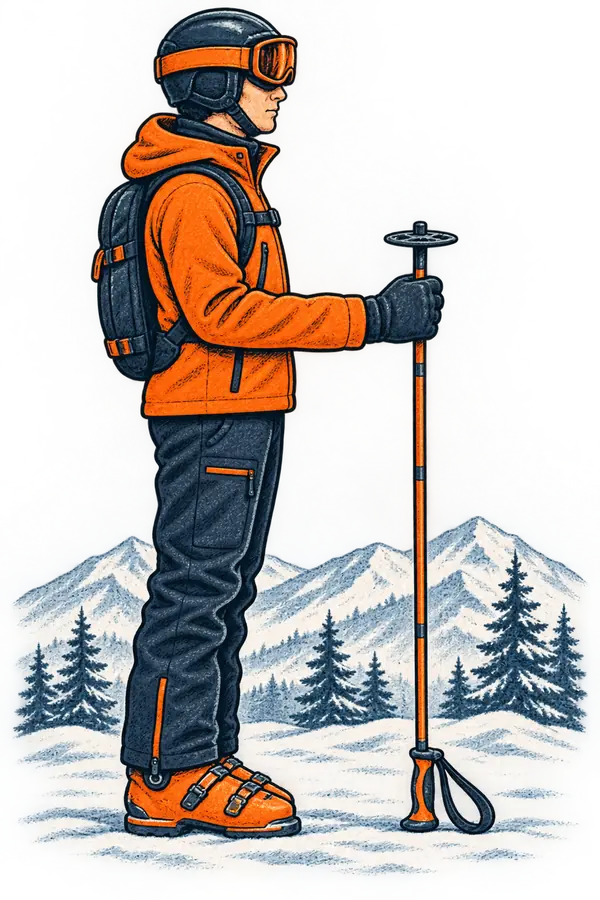
The upside-down test. Flip the pole and grip it just under the basket, handle on the floor. evo says your elbow should rest comfortably at your hip with your arm bent to roughly 90 degrees. Fischer adds that you should wear your ski boots with skis on your feet, and that the part above the basket plate is not counted. A level forearm means the right length.
The tape method. With no pole to hand, bend your elbow to 90 degrees and measure from the floor to your hand. evo says to add about two inches for the part of the pole that sinks into snow. Swix uses the same posture but takes the number as is, with no addition.
The height formula. Multiply by 0.7. It needs only a tape measure and a calculator, but Fischer is clear that it is a starting estimate: upper body length, leg length, style and preference all move the answer.
Take a skier who measures 120 cm from floor to hand with elbow at 90 degrees. Swix reads that as 1200 mm directly. evo adds two inches: 120 cm is about 47 inches, so 49 inches or roughly 125 cm. Those two brands are 5 cm apart for the same arm. This is why the upside-down test with a real pole usually settles it better than arithmetic. When in doubt, Swix says go shorter.
Cross-country formulas compared
| Source | Classic | Skate | Measured with |
|---|---|---|---|
| Fischer | height × 0.84 | height × 0.89 | Not stated |
| Swix | height minus 35 cm | height minus 22.5 cm | Boots on |
| Madshus chart | chart value | classic + 10 cm | Height in cm |
| Scheels chart | chart value | classic + 10 cm | Height in feet and inches |
Run a 175 cm skier through these. Fischer gives 147 cm classic and 155.75 cm skate. Swix gives 140 cm and 152.5 cm. The Madshus chart reads 145 and 155 at 175 cm, and Scheels lists 145 and 155 for 5'7" to 5'9". So classic ranges from 140 to 147, a 7 cm spread, and skate from 152.5 to 156.
Part of that gap is explained. Swix measures height in ski boots, so a skier whose bare-sole height is 175 cm is a few centimetres taller in boots and moves up the Swix table. The other part is that Swix's percentages differ: classic comes out near 80 percent of height at 175, Fischer's 84 percent.
The competition cap
Fischer notes that official competitions limit pole length to 83 percent of body height, measured with cross-country boots on, so the 0.84 formula can exceed it. Swix gives FIS maximum classic lengths: 1411 mm at 170 cm, 1494 mm at 180 cm, 1577 mm at 190 cm and 1701.5 mm at 205 cm. These caps cover classic poles only. Fischer says beginners should round down and competitors may round up.
Where to measure on the pole
Madshus makes a point most size charts skip. Measure to the point where the strap attaches to the handle, not the top of the grip, since attachment points differ between manufacturers. A pole listed at 150 cm from one brand can feel different from another listed at 150 cm. If you are buying online, check how the maker defines length.
Castanet's guide gives a simple on-snow check for classic: raise your arms comfortably, plant each pole angled back, and see whether it lands between your heel and the back of your boot. It also suggests buying slightly long, since grips can be removed and the shaft trimmed, but warns that overly long poles trip you.
Kids, adjustable poles and roller skis
Children outgrow poles quickly. Fischer says adjustable (vario) cross-country poles with a stable shaft can last a child several seasons, and evo makes the same point for alpine, where adjustable poles can keep pace with fast growth. Fischer adds that adult vario poles are generally used only off-track, since they are too heavy for groomed trails.
Roller skiing changes the measurement slightly. Madshus explains that roller skis sit higher off the ground, but the pole tip does not sink into pavement the way it sinks into snow, so the pole may need a small adjustment. Its advice is to measure with the snow baskets removed and roller-ski ferrules fitted. Use those ferrules on pavement, because snow baskets break easily there.
If you cannot test before buying, Fischer notes that many ski areas rent poles and will change the length for a small fee. That is a cheap way to try 5 cm shorter and 5 cm longer than the chart.
How this chart is built
The alpine rows come from the consensus of evo, Powder7, K2, Fischer, Leki, Salomon and Rossignol, which almost all land on 70 percent of height in 5 cm steps. Where a brand printed a range (Swix, Black Diamond) we listed it in its own column and left the main column on the consensus length. We did not average across brands, because averaging would produce lengths nobody makes. The cross-country table keeps the ranges that Rossignol, evo and Swix publish and adds the formulas that Fischer, Salomon and Swix state.
Questions
How do I know what size ski poles I need?
Turn the pole upside down and hold it just under the basket with the grip on the floor. Your elbow should bend to about 90 degrees with your forearm level. In numbers, alpine poles are about 70% of your height, rounded to the nearest 5 cm: a 5'10" skier takes a 125 cm (50 inch) pole.
Are ski poles sized in inches or centimetres?
Both. Alpine poles come in 5 cm steps, which brands also label in 2 inch steps: 110 cm is 44 in, 115 cm is 46 in, 120 cm is 48 in, 125 cm is 50 in, 130 cm is 52 in.
Should I size down if I am between pole sizes?
Yes. Swix says to take the shorter option when you fall between two lengths. Park skiers go shorter still, and Fischer suggests freeriders take about 5 cm off the recommended length.
Are cross-country poles longer than downhill poles?
Yes, by 20 to 36 cm at this height. A 175 cm skier takes about 120 cm for downhill, 140 to 147 for classic and 152 to 156 for skating, depending on the brand.
Which is more accurate, the formula or the elbow test?
Fischer says the formula is a starting estimate that ignores torso and leg length. The upside-down elbow test uses your own proportions, so most guides rely on it to confirm.
Related charts
 Ski size calculatorSki length from height, weight and ability
Cross-country ski size chartClassic and skate ski length
 Ski boot size chartShoe size to Mondopoint
- evo Ski Pole Size Chart, evo How to Choose Ski Poles and evo Cross-Country Ski Pole Size Chart
- Fischer, How Long Should Ski Poles Be and Fischer, Choose the Right Length of Cross-Country Pole
- Swix, Find Your Size: Alpine Poles and Swix, Find Your Size: Cross-Country Poles
- Leki, Salomon and Rossignol pole size charts as republished by their retailers Hardloop (Leki), The Trail (Salomon), Hardloop (Rossignol); the brands' own sites show an interactive advisor or no table
- Black Diamond pole sizing as republished by Whittaker Mountaineering
- Powder7 Ski Pole Size Chart, The Race Place, How to Size Ski Poles, Intersport Rent
- Madshus, How to Determine Correct Pole Length
- Scheels, How to Size Cross Country Ski Poles
- Castanet Kamloops, How to choose the right cross-country ski equipment
Added November 16, 2026 for the 2026/27 season (maker tables, model sizes, kids’ room to grow):