
Cross-country ski size chart
Enter your weight and height and choose classic, skate or backcountry touring. You get a ski length range built from the weight charts of Fischer, Madshus, Rossignol, Salomon, Atomic and Peltonen and the sizing tables of Nordic specialty shops, with the full chart below.
Short answer: Cross-country skis are sized by weight first: a 150 to 160 lb skier takes about 195 to 210 cm classic skis and 185 to 195 cm skate skis.
Every maker's number for you
Each maker's own chart for what you entered, side by side. Where they disagree, the result above is the overlap.
Fill in the calculator above to see each maker's own number.
Popular 2026/27 models in your size
The size each popular 2026/27 model comes in that is closest to your result, with a link to check prices.
Fill in the calculator above to see your size in each model.
Check the one you own
Enter the length of cross-country skis you already own to see whether they fit your weight and technique.
Shop this size
Enter your details above to get shopping links for your ski length.
Affiliate links. We may earn a commission at no cost to you. See the disclosure.Cross-country ski size chart by weight Printable card (PDF)
A cross-country ski is a spring. Its camber has to lift the grip zone off the snow when you glide on both skis and press it down when you kick on one, so the ski is matched to your weight before anything else. Gear West, evo, Scheels and Cross Country Ski HQ publish the same core weight table; the consensus column widens it where the manufacturers' own weight ranges reach further.
| Skier weight | kg | Classic | Skate | Backcountry / touring | Waxless package size |
|---|---|---|---|---|---|
| under 100 lb | under 45 | 176–185 | 165–175 | 159–166 | XS / S |
| 100–110 lb | 45–50 | 180–190 | 170–180 | 160–166 | S |
| 110–120 lb | 50–54 | 182–192 | 172–182 | 160–169 | S |
| 120–130 lb | 54–59 | 185–195 | 175–185 | 166–170 | S |
| 130–140 lb | 59–64 | 187–200 | 177–187 | 170–176 | M |
| 140–150 lb | 64–68 | 190–205 | 180–190 | 170–179 | M |
| 150–160 lb | 68–73 | 195–210 | 185–195 | 176–180 | L |
| 160–180 lb | 73–82 | 200–210 | 190–195 | 180–189 | L |
| 180–200 lb | 82–91 | 202–210 | 191–195 | 186–196 | XL |
| 200 lb and up | 91+ | 207–210, stiff | 192, stiff or extra-stiff | 196–206 | XL |
Where sources differ: for skiers over 180 lb Gear West and Cross Country Ski HQ give classic 200–210 while evo and Scheels give 205–210; for skate skis at 130–150 lb the upper bound is 187–190 (Gear West) or 190–195 (evo, Scheels). Madshus's skate weight bands are 30 kg wide and start lower than Fischer's.
Cross-country ski size chart by height
Height is the cross-check. Classic skis come out about 20 to 25 cm over your height (the old "wrist above your head" rule), skate skis 10 to 15 cm over, and backcountry skis near your height. Fischer says skate skis can be as little as 5 to 10 cm over height. If your weight row and height row disagree, trust the weight and pick a stiffer or softer flex.
| Height | cm | Classic | Skate | Backcountry | Nordic Skater (skate / combi / classic) | Madshus (classic / skate) |
|---|---|---|---|---|---|---|
| 4'9"–4'10" | 145–149 | 165–175 | 155–165 | 145–155 | 160 / 165 / 170 | 160–170 / 150 |
| 4'11"–5'1" | 150–156 | 170–180 | 160–170 | 150–160 | 165–170 / 170–175 / 175–180 | 170–175 / 155–165 |
| 5'2"–5'3" | 157–161 | 180–187 | 165–175 | 155–165 | 175 / 180 / 185 | 180–187 / 165–170 |
| 5'4"–5'5" | 162–166 | 182–192 | 170–180 | 160–170 | 180 / 185 / 190 | 182–192 / 170–175 |
| 5'6"–5'7" | 167–171 | 190–197 | 175–185 | 165–175 | 185 / 190 / 195 | 190–197 / 175–180 |
| 5'8"–5'9" | 172–176 | 192–200 | 180–190 | 170–180 | 190 / 195 / 200 | 192–200 / 180–185 |
| 5'10"–5'11" | 177–181 | 200–207 | 185–192 | 175–185 | 195 / 195 / 205 | 202–210 / 185–190 |
| 6'0"–6'1" | 182–186 | 202–210 | 190–195 | 180–190 | 195 / 195 / 205 | 202–210 / 190–195 |
| 6'2" and up | 187+ | 207–210 | 192–195 | 185–195 | 195 / 195 / 210 | 207–210 / 192–195 |
Manufacturer weight ranges by ski length
These are the weight ranges the brands print for their own skis, in kilograms. They show why the chart gives a range: a 75 kg (165 lb) skier fits a 197 cm Fischer classic ski in medium flex or a 192 in stiff, a 197 to 200 cm Madshus, and a 198 to 203 cm Rossignol.
| Ski | Length → skier weight (kg) |
|---|---|
| Fischer classic race (medium / stiff flex) | 187: under 50–59 · 192: 55–74 · 197: 60–74 / 70–84 · 202: 70–84 / 80–90 · 207: 75–90 / 85–90+ |
| Fischer Twin Skin Pro (skin classic) | 182: 50–69 · 187: 55–79 · 192: 60–84 · 197: 65–94 · 202: 70–84 · 207: 80–115 |
| Fischer skate (medium flex) | 171 and 176: under 50–54 · 181: 55–64 · 186: 60–74 · 191: 65–79 · 191 extra-stiff: 100–130 |
| Fischer backcountry (Adventure / Outback) | 159: under 55 · 169: 50–70 · 179: 66–86 · 189: over 84 (Outback 68: 169: 50–65 · 179: 60–80 · 189: 70–90 · 199: 80–100) |
| Madshus skate | 172: 30–60 · 177: 40–70 · 182: 50–80 · 187: 60–90 · 192: 70–100+ |
| Salomon skate (S/Lab, S/Max) | 170: 35–50 · 177: 45–60 · 182: 50–70 · 187: 60–80 · 192: 70–90 · 192 extra-stiff: 90–110 |
| Rossignol Delta skate | 173: 45–60 · 180: 55–70 · 186: 65–85 · 192: 80–95+ |
| Rossignol Delta Comp R-Skin classic (medium / stiff) | 186: 30–50 / 50–70 · 191: 40–60 / 60–80 · 198: 50–70 / 70–90 · 203: 60–80 / 80–100 · 208: 70–90 / 90–110 |
| Rossignol backcountry (BC 80, Evo OT 65) | 166: 40–60 · 176: 50–70 · 186: 60–80 · 196: 80–100 |
| Atomic skate (Pro S2, Redster S5) | 167: 40–50 · 173: 45–60 · 180: 55–75 · 186: 70–90 · 192: 75–100+ |
| Peltonen Infra classic (medium / stiff / extra-stiff) | 188: 45–55 / 55–65 / 65–80 · 195: 55–65 / 65–75 / 75–85 · 202: 65–75 / 75–90 / 90–110 · 207: 70–85 / 85–100 / 100–130 |
Kids' cross-country ski size chart
Children's skis are sized by height. Classic skis run from the child's height to about 20 cm over it: beginners height plus 10, advanced plus 10 to 20 (Fischer, Scheels, Kunstadt). Skate skis run from 5 to 10 cm under height for beginners to 5 to 10 cm over for advanced. Add 5 cm for a heavy child, take 5 cm off for a light one (Fischer).
| Child's height | cm | Classic | Skate | Madshus junior (classic / skate) |
|---|---|---|---|---|
| under 3'1" | under 95 | 90–100 | — | 90 / 90–100 |
| 3'1"–3'5" | 95–105 | 100–110 | — | 100–110 / 100–120 |
| 3'5"–3'9" | 105–115 | 110–120 | 100–110 | 110–120 / 100–120 |
| 3'9"–4'1" | 115–125 | 120–135 | 110–120 | 120–140 / 100–120 |
| 4'1"–4'5" | 125–135 | 130–145 | 120–135 | 130–150 / 130–140 |
| 4'5"–4'9" | 135–145 | 140–155 | 130–145 | 150–160 / 145–160 |
| 4'9"–5'1" | 145–155 | 150–165 | 140–155 | 170+ / 160–175 |
| 5'1"–5'5" | 155–165 | 160–180 | 150–165 | 170–197 / 160–175 |
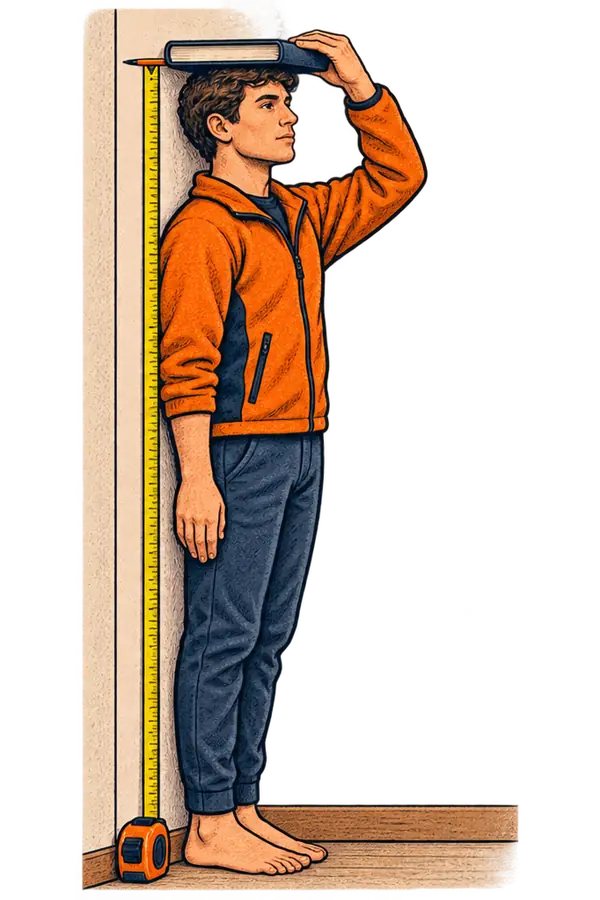
How to measure your height
How to check the fit
- The paper test (classic). Stand on both skis on a hard floor with your weight even. A friend should be able to slide a sheet of paper under the grip zone, from a little behind your heel to about 20 cm in front of your toe. Shift all your weight to one ski and the paper should be pinned. If it slides freely on one ski, the ski is too stiff; if it is pinned on two, too soft.
- Flex numbers. Shops that flex-test skis match a classic ski's camber to about half your body weight (50 to 55%, up to 60% for klister; skin skis 58 to 68%) and a skate ski's to 100 to 130% of body weight (Madshus, Cross Country Ski HQ, WebCyclery). Flex matters more than length.
- The height check. Stood on end, a classic ski should reach about your wrist with your arm raised; a skate ski about 10 cm less than that; a touring ski around head height.
- Grip or glide? Between two lengths or flexes, go softer or shorter for more grip and easier kicking, stiffer or longer for more glide and speed (Lakehead, Fischer).
- Poles. Classic poles are about 83 to 85% of your height, skate poles 88 to 90%. See the cross-country pole chart.
Worked example
Dana is 5'7" (about 170 cm) and weighs 144 lb with winter layers, and wants classic skis for groomed trails. Start with the weight chart: 144 lb falls in the 140–150 lb row, which gives classic 190–205 cm. Now the height chart: the 5'6"–5'7" row gives classic 190–197, with Madshus at 190–197 as well. The two overlap at 190–197, so the answer is 190 to 197 cm.
That still leaves two shelf sizes, probably 192 and 197. Dana is a recreational skier at the lower half of her weight row, and the Fischer ranges above put a 65 kg (143 lb) skier inside both a 192 and a 197 classic ski in medium flex. In that case take the 192: shorter is easier to kick and turn, and the paper test in the shop can confirm it. If the paper slides freely under the grip zone with weight on one ski, step up in stiffness before length.
Second case, Marcus: 5'2" (157 cm), 155 lb. His height row says classic 180–187, but his weight row says 195–210. When the rows disagree, weight wins, so he looks at 195 cm at the short end of his range. A 182 cm ski is matched to a much lighter skier, in the 110–120 lb row, and would likely drag its grip zone while he glides.
Another worked example: one skier, three answers
Take a skier who is 5'4" (64 inches, 163 cm) and weighs 140 lb. Here is what each method gives for classic skis.
- evo height formula: 64 × 2.6 + 15 = 181.4, so about 181 cm.
- SkatePro rule: 163 + 20 to 25 = 183 to 188 cm.
- evo weight chart: the 140 to 150 lb row says 190 to 205 cm. At exactly 140 lb the sensible reading is the low end of that range, around 190 to 195.
The height methods land near 181 to 188. The weight chart starts at 190. For skate skis the same person gets 64 × 2.6 + 5 = 171 cm from the formula and 180 to 195 from the weight chart, with the low end again closest at 180.
Which to follow? The weight chart, and the manufacturer's own table for the specific ski if you can find it. A 140 lb skier on a 181 cm ski chosen by height may land on a ski built for someone 20 lb lighter, and the grip zone will drag. If the weight row and height row disagree, go with the weight and pick a length at the short end of the range, since a short end gives you easier handling.
Classic and skate are different animals
Classic skis are longer and carry a grip zone under the foot, covered with wax or a textured skin. Skate skis have no grip zone and a different camber: stiff enough to stay flexed under a light load, soft enough to flatten when you push, according to the Castanet article. You cannot take a classic ski length and subtract a fixed number to get your skate length, because the stiffness requirement is different. The charts above handle that by giving separate ranges.
Touring skis are the shortest of the three in evo's table. They sit near your own height, with evo's formula listing height ±2 to 6 inches depending on skill, use and the ski.
Shorter or longer within the range
evo's advice for choosing within a range is concrete. Size shorter, closer to your chin, if you are a beginner or intermediate, weigh less than average for your height, or like quick turns. Size longer, nearer the top of your head, if you ski fast and aggressively, weigh more than average for your height, or ski mostly off trail. evo notes that a shorter ski is easier to turn but less stable than a longer one.
Wild Rock adds a rule of thumb: as skis get faster, they tend to get longer.
Checking the camber with paper
Tahoe Trail Guide describes a two-person test you can do in a shop with the actual skis. You need a sheet of paper.
- Stand on both skis in your normal ski stance. Your helper slides the paper under the grip zone. It should slide freely front to back. If it will not move, the skis are probably too short or too soft for you. If it slides well past the zone, they are probably too long or too stiff.
- Stand on one ski with the paper beneath it. Your helper tries to pull the paper out. If it will not come out without tearing, the ski is probably right. If it slides out easily, you are probably too light for that ski.
The author calls the test "not 100% accurate," because real kicking compresses the ski dynamically. If the result is unclear, try the next size down as well.
How this chart is built
We started with the weight tables that retailers publish (Gear West, evo, Scheels, Cross Country Ski HQ) and checked them against the weight ranges that Fischer, Madshus, Rossignol, Salomon, Atomic and Peltonen print for their own skis. Where retailers agreed we kept their numbers. Where they differed, as for skiers over 180 lb or skate skis at 130–150 lb, we showed the widest range both sides support instead of averaging, because the real answer depends on the ski model. The height table is a cross-check built from Nordic Skater, Madshus and retailer formulas, and the weight row takes priority when they conflict.
Questions
How long should cross-country skis be?
Classic skis are about 20 to 25 cm longer than your height and skate skis about 10 to 15 cm longer, up to a maximum of about 207 to 210 cm classic and 192 to 195 cm skate. But modern skis are sized by weight first: the camber has to match your weight, so a 150 lb skier takes a 195 to 210 cm classic ski whatever their height.
Are cross-country skis sized by height or weight?
Weight. Fischer, Madshus, Rossignol, Salomon and Atomic all publish a weight range for each ski length, because the ski's camber must be stiff enough to lift the grip zone off the snow when you glide and soft enough to press it down when you kick. Height is only a cross-check.
What length skate skis do I need?
About 10 to 15 cm over your height, chosen by weight: roughly 170 to 180 cm for skiers around 100 to 120 lb, 180 to 190 cm around 140 to 150 lb, and 190 to 195 cm above 160 lb. Skate skis top out at about 192 to 195 cm.
Are waxless skis sized differently?
No. Fischer, Rossignol and Salomon put their skin and fish-scale skis on the same weight grid as their waxable skis. Recreational waxless packages are often sold in S, M, L and XL by weight: Fischer's Orbiter, for example, is S 50–60 kg, M 65–80, L 75–90, XL over 90.
What if I am between two lengths?
evo suggests the shorter length if you are a beginner or lighter than average for your height, and the longer one if you ski fast or weigh more than average for your height.
Do I need to be heavier to ski a longer ski?
Heavier skiers need stiffer skis, and length follows from that. The top of the chart is fixed: evo lists 210 cm as the longest classic and 195 cm as the longest skate length for adults.
Related charts
 Cross-country pole lengthClassic and skate pole length from height
 Ski boot size chartShoe size to Mondopoint
Alpine ski size calculatorDownhill ski length from height and ability
- Fischer Nordic size selection chart (FW21/22 PDF, as hosted by Hardwood Ski and Bike), Fischer, What Ski Length Do I Need and Fischer's children's sizing article
- Madshus sizing via SkatePro (adult), SkatePro (junior) and madshus.com product pages and blog
- Rossignol, Salomon and Atomic Nordic weight ranges as published on evo (Rossignol), evo (Salomon), SkatePro and Coast Outdoors model pages; the brands' own sizing pages blocked automated reading
- Peltonen flex chart at Swiss Sports
- Retailer weight and height tables: Gear West, evo, Scheels, Cross Country Ski HQ, Nordic Skater, WebCyclery, Kunstadt, Boulder Nordic Sport
- evo, Cross-Country Ski Size Chart
- evo, Kids' Cross-Country Ski Size Chart
- Tahoe Trail Guide, Cross Country Skiing Explained Part 2: Geometry of Classic Skis
- Wild Rock, How to Choose a Classic Cross-Country Ski
- Castanet Kamloops, How to choose the right cross-country ski equipment
Added November 16, 2026 for the 2026/27 season (maker tables, model sizes, kids’ room to grow):