Ski boot size chart
Enter your shoe size, or better, your foot length, and get your Mondopoint ski boot size as a range from performance fit to comfort fit, with UK and EU equivalents. The chart below combines the published size charts of Salomon, Atomic, Nordica, Tecnica, Dalbello, Lange, Head, Fischer, K2 and Rossignol.
Short answer: Ski boots are sized in Mondopoint, your foot length in centimetres. A US men's 10 is Mondopoint 27.0 to 28.0 depending on the brand, and a US women's 8 is 24.0 to 25.0.
Every maker's number for you
Each maker's own chart for what you entered, side by side. Where they disagree, the result above is the overlap.
Fill in the calculator above to see each maker's own number.
Popular 2026/27 models in your size
The size each popular 2026/27 model comes in that is closest to your result, with a link to check prices.
Fill in the calculator above to see your size in each model.
Check the one you own
Enter the Mondopoint printed on the shell or liner of boots you already own to see whether they fit the size above.
Shop this size
Enter your size above to get shopping links for your Mondopoint size.
Affiliate links. We may earn a commission at no cost to you. See the disclosure.Men's ski boot size chart Printable card (PDF)
Mondopoint is your foot length in centimetres, so the chart is really a shoe-size-to-foot-length conversion, and brands disagree about it by up to a full size. The Mondopoint range runs from the performance fit (Nordica's chart, Head's and Surefoot's performance columns, one size tighter) to the comfort fit (Dalbello, Lange, Tecnica, K2, Fischer, Rossignol, Head's comfort column). Atomic sits in the middle. evo's chart is a half size roomier than the comfort column and Salomon's is about a half size tighter than the performance column.
| US men's | US women's | Mondopoint (performance–comfort) | Atomic | UK | EU | Foot length |
|---|---|---|---|---|---|---|
| 4 | 5 | 21.0–22.0 | 21.5 | 3 | 35 | 22.0 cm / 8.7 in |
| 4.5 | 5.5 | 21.5–22.5 | 22.0 | 3.5 | 36 | 22.5 cm / 8.9 in |
| 5 | 6 | 22.0–23.0 | 22.5 | 4 | 36.5 | 23.0 cm / 9.1 in |
| 5.5 | 6.5 | 22.5–23.5 | 23.0 | 4.5 | 37 | 23.5 cm / 9.3 in |
| 6 | 7 | 23.0–24.0 | 23.5 | 5 | 38 | 24.0 cm / 9.4 in |
| 6.5 | 7.5 | 23.5–24.5 | 24.0 | 5.5 | 38.5 | 24.5 cm / 9.6 in |
| 7 | 8 | 24.0–25.0 | 24.5 | 6 | 39 | 25.0 cm / 9.8 in |
| 7.5 | 8.5 | 24.5–25.5 | 25.0 | 6.5 | 40 | 25.5 cm / 10.0 in |
| 8 | 9 | 25.0–26.0 | 25.5 | 7 | 40.5 | 26.0 cm / 10.2 in |
| 8.5 | 9.5 | 25.5–26.5 | 26.0 | 7.5 | 41 | 26.5 cm / 10.4 in |
| 9 | 10 | 26.0–27.0 | 26.5 | 8 | 42 | 27.0 cm / 10.6 in |
| 9.5 | 10.5 | 26.5–27.5 | 27.0 | 8.5 | 42.5 | 27.5 cm / 10.8 in |
| 10 | 11 | 27.0–28.0 | 27.5 | 9 | 43 | 28.0 cm / 11.0 in |
| 10.5 | 11.5 | 27.5–28.5 | 28.0 | 9.5 | 44 | 28.5 cm / 11.2 in |
| 11 | 12 | 28.0–29.0 | 28.5 | 10 | 44.5 | 29.0 cm / 11.4 in |
| 11.5 | 12.5 | 28.5–29.5 | 29.0 | 10.5 | 45 | 29.5 cm / 11.6 in |
| 12 | 13 | 29.0–30.0 | 29.5 | 11 | 45.5 | 30.0 cm / 11.8 in |
| 12.5 | 13.5 | 29.5–30.5 | 30.0 | 11.5 | 46 | 30.5 cm / 12.0 in |
| 13 | 14 | 30.0–31.0 | 30.5 | 12 | 47 | 31.0 cm / 12.2 in |
| 13.5 | 14.5 | 30.5–31.5 | 31.0 | 12.5 | 47.5 | 31.5 cm / 12.4 in |
| 14 | 15 | 31.0–32.0 | 31.5 | 13 | 48 | 32.0 cm / 12.6 in |
| 14.5 | 15.5 | 31.5–32.5 | 32.0 | 13.5 | 48.5 | 32.5 cm / 12.8 in |
| 15 | 16 | 32.0–33.0 | 32.5 | 14 | 49 | 33.0 cm / 13.0 in |
EU sizes are from the Dalbello and Lange charts, which most brands match to within half a size; Fischer's EU column runs about two sizes smaller above Mondopoint 30. UK sizes are consistent across brands at one below US men's.
Women's ski boot size chart
Women's boots use the same Mondopoint scale. A US women's size converts one number higher than the men's size for the same foot (a women's 9 and a men's 8 are both about 26 cm), so a women's 9 is a 25.0 to 26.0 boot. Nordica, Dalbello, Lange, Tecnica and K2 all use that rule; Surefoot and Head list a performance fit one size down.
| US women's | Mondopoint (performance–comfort) | evo chart | UK | EU | Foot length |
|---|---|---|---|---|---|
| 4 | 20.0–21.0 | 21.5 | 2 | 34 | 21.0 cm / 8.3 in |
| 4.5 | 20.5–21.5 | 22.0 | 2.5 | 35 | 21.5 cm / 8.5 in |
| 5 | 21.0–22.0 | 22.5 | 3 | 35–36 | 22.0 cm / 8.7 in |
| 5.5 | 21.5–22.5 | 23.0 | 3.5 | 36 | 22.5 cm / 8.9 in |
| 6 | 22.0–23.0 | 23.5 | 4 | 36–37 | 23.0 cm / 9.1 in |
| 6.5 | 22.5–23.5 | 24.0 | 4.5 | 37 | 23.5 cm / 9.3 in |
| 7 | 23.0–24.0 | 24.5 | 5 | 37–38 | 24.0 cm / 9.4 in |
| 7.5 | 23.5–24.5 | 25.0 | 5.5 | 38 | 24.5 cm / 9.6 in |
| 8 | 24.0–25.0 | 25.5 | 6 | 38–39 | 25.0 cm / 9.8 in |
| 8.5 | 24.5–25.5 | 26.0 | 6.5 | 39 | 25.5 cm / 10.0 in |
| 9 | 25.0–26.0 | 26.5 | 7 | 39–40 | 26.0 cm / 10.2 in |
| 9.5 | 25.5–26.5 | 27.0 | 7.5 | 40 | 26.5 cm / 10.4 in |
| 10 | 26.0–27.0 | 27.5 | 8 | 40–41 | 27.0 cm / 10.6 in |
| 10.5 | 26.5–27.5 | 28.0 | 8.5 | 41 | 27.5 cm / 10.8 in |
| 11 | 27.0–28.0 | 28.5 | 9 | 42 | 28.0 cm / 11.0 in |
| 11.5 | 27.5–28.5 | 29.0 | 9.5 | 42.5 | 28.5 cm / 11.2 in |
| 12 | 28.0–29.0 | 29.5 | 10 | 43 | 29.0 cm / 11.4 in |
Women's 4 and 4.5 appear only in Surefoot's chart; the rows above follow the same rule as the rest of the table.
Kids' ski boot size chart
Kids' boots are sized the same way, foot length in centimetres. Fischer suggests leaving a 1 to 1.5 cm gap in front of the toes so the boot lasts a season of growth; Head recommends the comfort fit for children. US kids' sizes run from toddler (C) sizes up to 13.5C, then restart at youth 1 and run into adult men's sizing at about youth 7.
| US kids' | Mondopoint | UK | EU | Sources |
|---|---|---|---|---|
| 8C | 14.0–15.5 | 7 | 24–25 | Surefoot 14.0, Dalbello and Head 15.0, evo and Rossignol 15.5 |
| 9C | 15.0–16.5 | 8 | 25–26 | Surefoot 15.0, Dalbello and Head 16.0, evo 16.5 |
| 10C | 16.0–17.5 | 9 | 26–27 | Surefoot 16.0, Dalbello and Head 17.0, evo 17.5 |
| 11C | 17.0–18.5 | 10 | 27–28 | Surefoot 17.0, Dalbello and Head 17.5, evo 18.5 |
| 12C | 18.0–18.5 | 11 | 29 | Surefoot 18.0, Dalbello and Head 18.5, evo 18.5 |
| 13C | 19.0–19.5 | 12 | 30–30.5 | Surefoot 19.0, Dalbello, Head, evo and Rossignol 19.5 |
| Youth 1 | 19.0–20.5 | 13 | 31–32 | Surefoot 19.0, Head junior 20.0, Dalbello 20.5, evo 20.5 |
| Youth 2 | 20.0–21.5 | 1 | 32–33 | Surefoot 20.0, Dalbello and Head 21.0, evo 21.5 |
| Youth 3 | 21.0–22.0 | 2 | 33–34 | Surefoot 21.0, Dalbello and evo 21.5, Head 22.0 |
| Youth 4 | 22.0–22.5 | 3 | 35 | Surefoot, Dalbello, Head 22.0; evo 22.5 |
| Youth 5 | 23.0–23.5 | 4 | 36–36.5 | Surefoot, Dalbello, Head 23.0; evo 23.5 |
| Youth 6 | 24.0–24.5 | 5 | 38 | Surefoot, Dalbello, Head 24.0; evo 24.5 |
| Youth 7 | 25.0–25.5 | 6 | 39 | Surefoot, Dalbello, Head 25.0; evo 25.5. Same as adult men's 7. |
How each brand converts a US men's 10
This is why the chart shows a range. Every chart below is the brand's own or its authorised retailer's; a US men's 10 comes out anywhere from 27.0 to 28.5.
| Brand chart | US men's 10 = | Rule |
|---|---|---|
| Nordica (Peter Glenn chart), Head performance fit, Surefoot performance fit | 27.0 | US men's + 17 |
| Salomon | 27.0–27.5 | Salomon pairs two half sizes per shell; its US numbers run about a size tighter than most brands |
| Atomic | 27.5 | US men's + 17.5 |
| Dalbello, Lange, Tecnica, Head comfort fit, K2, Fischer, Rossignol, Surefoot standard | 28.0 | US men's + 18 |
| evo size chart | 28.5 comfort / 27.5 performance | US men's + 18.5 / + 17.5 |
Flex and width
| Ability | Men's flex | Women's flex | Source |
|---|---|---|---|
| Beginner | below 85 | below 75 | K2: "ideal for beginners" |
| Intermediate | 90–110 | 80–95 | K2; Carv gives casual men 80–110, casual women 60–80 |
| Advanced / expert | 115 and up | 100 and up | K2; Carv gives aggressive men 120+, aggressive women 80+ |
Last width is the width of the shell at the forefoot, quoted for a 26.5 boot. Narrow lasts are 97 to 98 mm, medium about 100 mm, wide 102 mm and above (evo, Carv, Atomic). Tecnica labels these LV (93–98 mm), MV (99–100 mm) and HV (103 mm). Atomic's Hawx chart shows the last growing about 2 mm per size, from 92 mm at 22.5 to 104 mm at 28.5.
How to check the fit
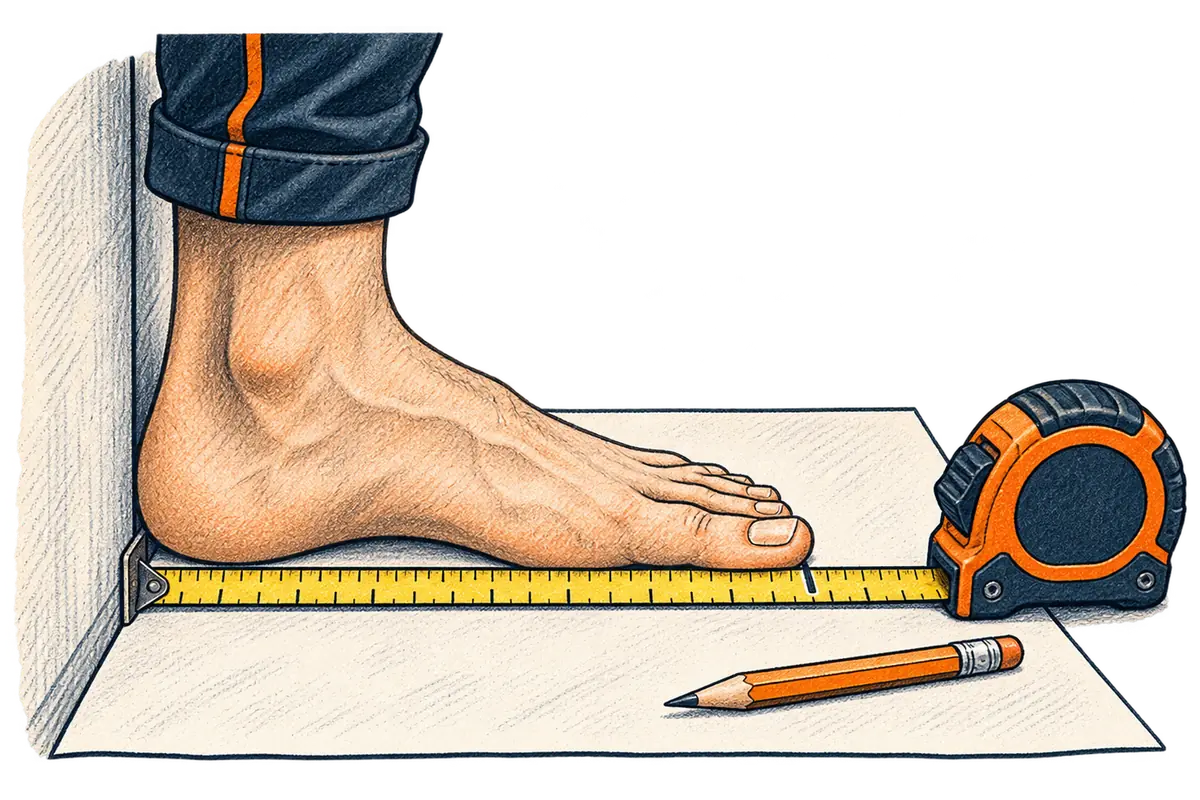
- Measure your foot. Stand on paper with your heel against a wall, in a ski sock, with weight on the foot. Mark the end of your longest toe and measure in centimetres. That number is your Mondopoint (evo, K2, Surefoot, Fischer). Measure both feet and use the longer.
- Shell fit. Pull the liner out, stand in the bare shell with your toes touching the front, and look at the gap behind your heel. About 1.5 to 2 cm, or two fingers, is a comfort fit for beginners and intermediates; about 1 cm, one finger, is a performance fit (Surefoot, Carv).
- With the liner in, your toes should touch the front when you stand up straight and pull back slightly when you flex forward. Liners pack out, so a boot that feels snug on day one is right.
- Between sizes? Rossignol and Nordica say go up, but only if the shell check agrees. Most sizing regret comes from boots that are too big.
- Width before size. If the boot is painful across the forefoot but the length is right, you need a wider last, not a longer boot.
Worked example
Dana wears a US women's 9 sneaker and skis blue and black runs about ten days a year. Step one is the women's chart: a women's 9 is Mondopoint 25.0 to 26.0, with 25.0 the performance end and 26.0 the comfort end. Because she skis regularly and wants control, we start at the tighter end and look at 25.5 and 25.0 boots.
Then she measures her foot as the guide describes: 25.4 cm in ski socks, longer foot. That sits inside the range, so the chart and the tape agree. A 25.5 is the natural pick.
The in-between case is Marcus, a US men's 10 with a measured foot of 27.3 cm. The men's chart gives 27.0 to 28.0, and his foot falls between the 27.0 and 27.5 rows. Rounding up to 27.5 or down to 27.0 can mean two different shells, since most brands share one shell between two half sizes. He does the shell check on the 27.5: bare shell, toes at the front, and about 1 cm (one finger) behind the heel, a performance fit. If he finds two fingers, he drops to 27.0, which is the smaller shell. Rossignol and Nordica say go up when between sizes, but only if the shell check agrees, so the gap, not the rounding, decides.
Mondopoint is a foot length, not a shell
Mondopoint is your foot length in centimetres. Mondopoint is an international system built on foot length in millimetres, so a 26.5 cm foot is a size 26.5 and a 265 mm foot is the same thing (Carv). That makes it the one number every brand shares, and it is why a street shoe size is only a starting guess. evo says a shoe-size conversion "works in a pinch" but is less accurate than measuring. Jans goes further and does not recommend converting a shoe size at all. If you have not measured your foot yet, do that first with the home measuring guide.
The trouble is that a Mondopoint tag on a boot does not mean the inside of the boot is that long. Brands build to different tolerances, so the same foot lands on different numbers depending on how the brand converts shoe sizes. For a US men's 10, Nordica's standard fit is 28 and its performance fit is 27 (Surefoot, reproducing Nordica's chart). evo's chart gives 28.5 for comfort and 27.5 for performance. Our ski boot size chart lines up these brand differences side by side.
Shell size is the part you cannot change
Boot makers do not build a separate shell for every half size. Carv puts it plainly: "the size of the shell actually doesn't change between a 25 (250mm) and a 25.5 (255mm)." Jans says whole and half sizes often share a shell, with the differences in the liner. Peter Glenn describes shells in whole sizes (26, 27, 28) with liners making up the half sizes through thickness changes.
Carv groups shells into letter sizes, which shows how wide each shell band is:
| Shell | Mondopoint range it covers (Carv) |
|---|---|
| D | 22.0 to 24.5 |
| E | 25.0 to 27.5 |
| F | 28.0 to 30.5 |
Brands cut their shell bands differently, and the Carv grouping is one example, not a standard. The point is what it does to you. A skier at 27.5 in one brand and a skier at 28.0 in the same brand may be choosing between two different shells, and the shell is what a bootfitter cannot easily resize. Carv and Jans both advise that when you fall between two sizes you take the smaller one. Jans gives the reason: the liner packs out over time, a fitter can widen key areas of the shell, and a boot that is too big is much harder to fix.
Comfort fit and performance fit
Fit style is how far below your measured length the boot is sized. evo describes comfort fit as roomier, suited to beginners and intermediates who ski a few times a season on groomed terrain at moderate speeds. Performance fit suits intermediate to advanced skiers on varied terrain at speed. Nordica's guidance matches: performance fit for intermediate-to-advanced skiers who ski regularly, standard fit for beginner-to-intermediate skiers who ski less often.
| Skier | Suggested size relative to your Mondopoint | Source |
|---|---|---|
| Beginner to intermediate | Close to your measurement or slightly larger | evo |
| Intermediate to advanced | Close to or slightly smaller, in a stiffer flex | evo |
| Advanced to expert | Up to a full size smaller, with a stiff or very stiff flex; usually needs a skilled bootfitter | evo |
evo warns that "the tighter the fit, the more control you will have over your skis," but that tighter fits can also cause pressure points and pain. Carv offers a practical tiebreaker: if in doubt, go with the performance fit, because a fitter can stretch tight spots but cannot shrink a boot that is too big.
The shell check
This is the test that settles size, and it takes two minutes in a shop. Take the liner out, put your foot in the bare shell wearing a thin ski sock, and slide forward until your toes touch the front. Then look at the space behind your heel.
| Gap behind heel | What it means | Source |
|---|---|---|
| About 15 to 20 mm, one to two fingers | Roughly the standard range; tighter for stronger skiers | Surefoot |
| One finger, a little more than 1/4 inch | Performance fit | GearX |
| Two stacked fingers, about 3/4 inch | Comfort fit; GearX suggests it for cold-prone feet or boots without a heat-mouldable liner | GearX |
| No more than two fingers (comfort) or one finger (performance) | Carv's intermediate guidance | Carv |
Bend your knees with your heels down when you check the gap, as GearX describes, because a standing gap overstates the room. Surefoot adds two more checks: your heel should stay down when you flex forward, and your foot should not press into the sides when you stand tall.
Once the liner is back in, buckle the boot to skiing tightness. Ideally your toes lie flat against the front of the liner (GearX). Peter Glenn describes a performance fit as toes lightly touching when you stand and pulling back slightly in the skiing position. If you have to bottom out the buckles to get the boot snug, GearX says the boot may have too much volume and a lower-volume model may suit you better.
Last width in millimetres
Last width is the width of the boot at the ball of the foot, quoted in millimetres for a sample size. Three sources give three slightly different bands:
| Width | evo (Greg Louie) | Carv | Peter Glenn |
|---|---|---|---|
| Narrow | 97 mm and up | 97 to 100 mm | 97 to 98 mm |
| Medium | around 100 mm (average) | 100 to 102 mm | 99 to 101 mm |
| Wide | 102 mm and above | over 102 mm | 102 mm and above |
The boundaries overlap by a millimetre or two, so a boot listed at 100 mm is "medium" in all three but a 101 mm boot could be called medium or wide-ish depending on who is talking. Use the numbers to compare boots with each other, not to label your foot. Carv shows how to measure yours: mark the widest point on your foot on the paper and measure from the paper's edge to that mark. evo says last width depends mostly on foot structure and that advanced skiers typically pick narrower lasts for a snug fit. Jans notes that lasts differ between models, so a Salomon 27.5 can fit quite differently from a Tecnica 27.5.
If the boot is painful across the forefoot but the length is right, the answer is a wider last or a bootfitter's punch on the shell, not a longer boot. Going longer to fix width is the usual way people end up with heel lift.
Another worked example: a 27.0 cm foot
Say your longest foot measures 27.0 cm standing in a ski sock, and you are an intermediate who skis 10 to 15 days a year. Your Mondopoint is 27.0. Under evo's table, an intermediate-to-advanced skier takes a size close to or slightly smaller, so the realistic candidates are 26.5 and 27.0. A skier who skis rarely would look at 27.0 or 27.5.
Now the shell check. You try a 27.0 and a 26.5 from the same brand. They may share a shell, in which case the difference is the liner, and the bare-shell gap will be identical. If the 27.0 shows two fingers behind the heel and the 26.5 uses the same shell, the shell is on the roomy side for you and you should look at the next shell down, or a lower-volume model. If the gap is one finger, you have a performance fit, and the choice between 26.5 and 27.0 comes down to toe feel in the liner. Because liners pack out, and Peter Glenn puts that at 3 to 5 mm after break-in, a boot that is snug on day one is where you want to start.
How this chart is built
We started from the published size charts of Salomon, Atomic, Nordica, Tecnica, Dalbello, Lange, Head, Fischer, K2 and Rossignol, plus the conversion charts at evo and Surefoot. Several brand sites blocked automated reading or show the chart only as an image, so those charts come from authorised retailers such as Peter Glenn, SkatePro and Skirack. The sources are listed at the bottom of the page.
The charts disagree by up to a full size for the same shoe size. Rather than average them, which would produce a number no brand prints, the Mondopoint column shows a range: the tightest brand rule on the left, the roomiest on the right. We treated the performance fit as one size below the comfort fit, as Nordica, Head and Surefoot do.
Questions
What is Mondopoint?
Mondopoint is the length of your foot in centimetres, measured from heel to longest toe. A 28.0 boot fits a 28 cm foot. It is the only sizing system every ski boot brand shares, which is why boots are labelled in it.
What ski boot size is a US men's 10?
Most brand charts put a US men's 10 at Mondopoint 27.0 to 28.0: 28.0 for a comfort fit (Dalbello, Lange, Tecnica, K2, Fischer, Head), 27.0 for a performance fit (Nordica, Head's performance column), and 27.5 at Atomic. Measure your foot to be sure.
Should ski boots be a size smaller than shoes?
Usually, yes. Ski boots are sized to your actual foot length while street shoes have extra room, so a well-fitted boot is often a half to a full size smaller than your sneaker size in Mondopoint terms. The shell fit test, with 1 to 2 cm behind your heel, settles it.
Do half sizes matter?
Not for the shell. Almost every brand uses one shell for two half sizes (27.0 and 27.5 share a shell) and changes only the liner or footbed. If you are between a 27.5 and a 28.0, you are choosing between two different shells, so do the shell fit test.
Should I measure both feet?
Sources split. Surefoot and Peter Glenn say to use the longer foot. Jans suggests sizing to the smaller one. A shell check on both feet in the actual boot settles it, and a fitter can stretch the shell for the larger foot.
What gap should I have behind my heel?
Surefoot gives about 15 to 20 mm for the bare-shell check, one to two fingers. GearX describes one finger as performance fit and two as comfort fit. Heel gap in the shell is a different thing from heel lift when skiing, which means the boot is too big.
What flex should I buy?
K2 puts medium flex at 90 to 110 for men and 80 to 95 for women, with soft below 85 and 75 and stiff above 115 and 100. Pick the band for your ability, then let fit decide among boots in it.
Related charts
 Ski size calculatorSki length from height, weight and ability
 Ski pole size chartPole length from height
Snowboard boot size chartShoe size to snowboard boot size
Ski boot sizes by brandEvery maker's size and boot sole length
 Ski helmet size chartHead size to helmet size
- evo, Ski Boot Size Chart and Mondopoint Conversion and evo, Tecnica Ski Boot Size Chart
- K2, How to Choose Ski Boots (size chart and flex bands)
- Fischer, Ski Boots: Fit Well, Ski Well
- Surefoot, Ski Boot Size Chart: Mondopoint Conversion (standard and performance fit, kids)
- Brand charts republished by authorised retailers: Nordica, Dalbello, Lange, Atomic and Rossignol (Peter Glenn); Head, Salomon men's, Salomon women's, Fischer, Atomic Hawx (SkatePro); Rossignol (Skirack). The brand sites themselves blocked automated reading or publish the chart only as an image.
- Scheels, Mondopoint Conversion (Mondopoint to inches)
- Fit, last and flex: Carv, Ski Boot Sizing Guide; K2 and Surefoot as above
- Carv, Ski Boot Size Chart and Mondopoint Size Guide
- GearX, How to Size Ski Boots
- Jans, Mondopoint Sizing Explained
- Peter Glenn, Understanding Mondopoint Sizing
Added November 16, 2026 for the 2026/27 season (maker tables, model sizes, kids’ room to grow):
- evo's 2027 product pages (last width and flex for each 2026/27 boot listed)
- Surefoot, Junior Ski Boots (why kids should not get boots two sizes too big)
- Nordica ski boot size chart (PDF) (Nordica's own standard and performance fits, used in the maker table)