Snowboard size calculator
Enter your weight, height, boot size and how you ride. You get a board length range and the waist width you need, built from the published charts of Jones, K2, Ride, Salomon, Burton, evo and REI. The full chart is below.
Short answer: Snowboard makers size by weight first: a 150 to 160 lb rider takes a 150 to 157 cm all-mountain board, 2 to 4 cm longer for powder and 2 to 4 cm shorter for park.
Every maker's number for you
Each maker's own chart for what you entered, side by side. Where they disagree, the result above is the overlap.
Fill in the calculator above to see each maker's own number.
Popular 2026/27 models in your size
The size each popular 2026/27 model comes in that is closest to your result, with a link to check prices.
Fill in the calculator above to see your size in each model.
Check the one you own
Enter the length of the board you already own to see whether it fits your weight and riding.
Shop this size
Enter your details above to get shopping links for your size.
Affiliate links. We may earn a commission at no cost to you. See the disclosure.Snowboard size chart by weight Printable card (PDF)
Weight is the number every brand sizes by, because it decides how the board flexes. The consensus column is the span of the three published charts beside it. Pick the shorter end for park riding or your first season, the longer end for powder and speed.
| Rider weight | kg | Board length (consensus) | Jones | REI | evo |
|---|---|---|---|---|---|
| under 100 lb | under 45 | 132–143 cm | 137–143 | — | 132–148 |
| 100–110 lb | 45–50 | 138–146 cm | 140–145 | 128–136 | 138–152 |
| 110–120 lb | 50–54 | 140–148 cm | 142–147 | 128–136 | 140–155 |
| 120–130 lb | 54–59 | 142–150 cm | 144–149 | 133–141 | 142–158 |
| 130–140 lb | 59–63 | 145–152 cm | 146–151 | 139–147 | 145–160 |
| 140–150 lb | 63–68 | 148–155 cm | 148–153 | 144–152 | 148–162 |
| 150–160 lb | 68–73 | 150–157 cm | 150–155 | 149–157 | 150–162 |
| 160–170 lb | 73–77 | 152–159 cm | 152–157 | 154–162 | 152–164 |
| 170–180 lb | 77–82 | 154–161 cm | 154–159 | 159–167 | 155–166 |
| 180–190 lb | 82–86 | 156–163 cm | 156–161 | 160+ | 158+ |
| 190–200 lb | 86–91 | 158–164 cm | 158–163 | 160+ | 158+ |
| 200–210 lb | 91–95 | 160–166 cm | 160–165 | 160+ | — |
| 210–220 lb | 95–100 | 162–168 cm | 162–167 | 160+ | — |
| 220 lb and up | 100+ | 164–170 cm | 164–169 / 165+ | — | — |
Snowboard size chart by height
Height is the second input. Brands disagree more here: K2 and Ride run 2 to 6 cm longer than evo at the same height, and Burton says not to size by height at all. Salomon's rule for an all-mountain board is chin height, or your height minus 20 cm.
| Height | cm | evo | K2 / Ride, under 130 lb | K2 / Ride, 130–180 lb | K2 / Ride, over 180 lb | Salomon chin rule |
|---|---|---|---|---|---|---|
| 4'10" | 147 | 132–148 | — | — | — | 127 |
| 5'0" | 152 | 138–152 | 138–144 | 142–148 | 146–152 | 132 |
| 5'2" | 158 | 140–155 | — | — | — | 138 |
| 5'4" | 163 | 142–158 | 144–150 | 148–154 | 152–158 | 143 |
| 5'6" | 168 | 145–160 | — | — | — | 148 |
| 5'8" | 173 | 148–162 | 150–156 | 154–160 | 158–164 | 153 |
| 5'10" | 178 | 150–162 | — | — | — | 158 |
| 6'0" | 183 | 152–164 | 156–162 | 160–166 | 164–170 | 163 |
| 6'2" | 188 | 155–166 | — | — | — | 168 |
| 6'4"+ | 193 | 158+ | — | — | — | 173 |
Adjusting for riding style and ability
| You ride | Change | Who says so |
|---|---|---|
| All-mountain | Baseline, no change | All sources |
| Freestyle / park | 2–4 cm shorter | K2 and Ride "2–4 cm"; Jones "2–3 cm"; Salomon "a few cm"; evo, REI, Burton "shorter" |
| Freeride / powder | 2–4 cm longer | K2 and Ride "2–4 cm"; Jones "2–3 cm"; Salomon 3–5 cm above chin height |
| Beginner | 1–2 cm shorter, lower end of range | Jones "1 to 2 cm shorter"; K2, Ride, evo, Salomon "shorter" |
| Advanced / expert | Middle to upper end of range | Jones, Salomon |
| Volume-shifted or wide-waist board | 3–6 cm shorter than your normal board | Lib Tech "six centimeters"; Arbor "3–5 cm" |
Snowboard width chart by boot size
Boot size decides the waist width, not the length. Your boots should hang over each edge by about 1 to 2 cm (REI, Ride). Too much overhang and you drag your toes in a carve; too little and you can't lever the board onto its edge. K2, Ride and REI publish the same table; evo's categories are about 5 mm narrower; Burton and Jones give thresholds.
| Men's US boot | Women's US boot | Waist width | Board width | Notes |
|---|---|---|---|---|
| up to 7.5 | up to 6 | 225–235 mm | Narrow / women's | evo |
| 6–8 (K2, REI); 7–9.5 (evo) | 7.5–9.5 (K2, REI); 6–8.5 (evo) | 235–245 mm | Regular | Burton and Jones: under men's 9–10 fits any regular board |
| 8–9.5 (K2, REI); 8.5–10.5 (evo) | 9.5–11 (K2, REI); 8–10.5 (evo) | 245–255 mm | Regular to mid-wide | evo splits 246–250 mid-wide, 251–254 wide |
| 10–11.5 | 11.5+ | 255–260 mm | Mid-wide | Jones: minimum 259 mm at men's 10; Salomon: above EU 44 (US 10.5) go mid-wide or wide |
| 11.5–12+ | 13+ | 260–265+ mm | Wide | Burton: 11–12 "may want" wide, over 12 "almost certainly"; Jones 263 mm+ at men's 11 |
Kids' snowboard size chart
evo is the one source with a general youth chart. The rule is that the board, stood on end, reaches between the child's chest and chin. A light child for their height takes the shorter end, a heavy one the longer end. Burton sizes kids' boards by the weight range printed on each model.
| Age | Height | Weight | Board length |
|---|---|---|---|
| 3 | 3'1" / 94 cm | 34 lb / 14 kg | under 80 cm |
| 4 | 3'4" / 102 cm | 37 lb / 16 kg | 80–90 cm |
| 5 | 3'7" / 109 cm | 42 lb / 18 kg | 85–95 cm |
| 6 | 3'9" / 114 cm | 46 lb / 21 kg | 90–100 cm |
| 7 | 3'11" / 119 cm | 50 lb / 23 kg | 95–105 cm |
| 8 | 4'2" / 127 cm | 57 lb / 26 kg | 100–109 cm |
| 9 | 4'5" / 135 cm | 63 lb / 29 kg | 105–119 cm |
| 10 | 4'7" / 140 cm | 70 lb / 32 kg | 110–125 cm |
| 11 | 4'9" / 145 cm | 79 lb / 36 kg | 115–129 cm |
| 12 | 4'11" / 149 cm | 89 lb / 41 kg | 125–135 cm |
| 13 | 5'2" / 156 cm | 100 lb / 46 kg | 130–145 cm |
| 14 | 5'5" / 164 cm | 112 lb / 51 kg | 140–149 cm |
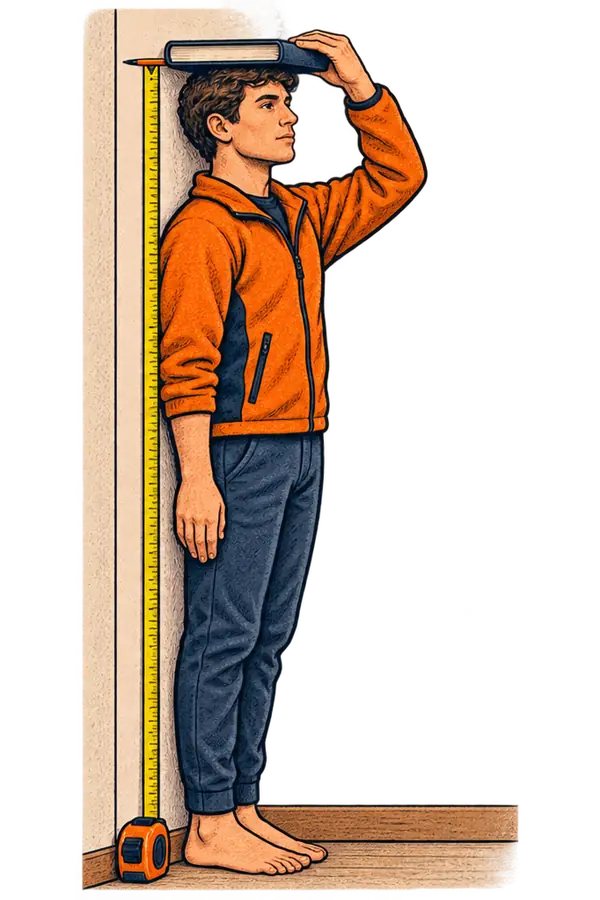
How to measure your height
How to check the fit
- Stand it up. An all-mountain board should reach between your chin and your nose (REI, Ride, evo, Salomon). Shorter than your chin is a park length; above your nose is a powder length.
- Check the weight range on the board. Every brand prints a recommended rider weight for each length. Burton says this is the number that matters. You should sit inside it, ideally not at the very top or bottom.
- Check the overhang. Mount your boots or stand on the board in them: 1 to 2 cm of boot past each edge is right. More than that, go to a mid-wide or wide board.
- Flex it. A board that is too long for your weight will feel stiff and hard to turn; too short will feel washy at speed. Beginners do better on the shorter, softer end.
Worked example
Dev is 6'0" (183 cm), weighs 185 lb (84 kg) and wears men's size 10.5 boots. He rides all-mountain at an intermediate level and likes the occasional powder day.
Step 1: the weight chart. 180–190 lb gives a consensus of 156–163 cm. Jones says 156–161, and REI and evo are open-ended at 160+ and 158+.
Step 2: the height chart. At 6'0", K2 and Ride list 164–170 cm for riders over 180 lb, evo lists 152–164, and Salomon's chin rule says 163. Height pushes higher than weight does.
Step 3: reconcile. The two charts overlap at 163 to 164 cm, so that is the core of the range. For powder days the style table adds 2–4 cm, so a 165 or 166 board is reasonable if he rides off-piste often.
Width: men's 10.5 lands in the 255–260 mm row, and Jones's minimum at this size is 261 mm, so he should check the waist of the exact model and pick mid-wide.
The case that lands between sizes: the board he likes comes in a 162 and a 165. The weight chart prefers the 162, the height chart the 165. As an intermediate who mostly rides groomed runs, he takes the 162, in a mid-wide waist. If most of his days were powder, the 165.
More worked examples
Alex: 5'8", 165 lb, men's 9.5 boots, all-mountain
165 lb is 75 kg. Jones has two rows that include 165: 155–170 lb at 152–157 cm and 165–180 lb at 154–159 cm, so the middle size is 154 to 157. K2 at 173 cm and 130–180 lb gives 154–160. Salomon's chin rule gives 173 − 20 = 153. REI, which runs longer, gives 159–167 for 160 to 175 lb. With Jones that gives a shared span of 154 to 157.
That is where Alex lands, and the choice between a 155 and a 157 board comes down to riding. If he rides groomers and wants something quick edge to edge, 155. If he heads off-piste, K2's 2 to 4 cm longer suggests 157 to 159. Width: men's 9.5 sits in K2's 245–255 mm row and under Jones's size 10 threshold, so a regular board works.
Mei: 5'4", 135 lb, women's 8.5 boots, first season
135 lb is 61 kg, which sits on the edge of two Jones rows (125–140 at 146–151, and 135–150 at 148–153). Jones says to take the middle size, so 148 to 151. K2 for 163 cm and 130–180 lb says 148–154. Salomon's chin rule gives 143, which is the low outlier.
As a beginner, Jones suggests 1 to 2 cm shorter, which moves the target to about 147 to 150. Mei picks a 148 or 149. Her women's 8.5 is inside K2's 7.5–9.5 band, so the waist should be 235 to 245 mm. A board labelled for women often has a narrower waist already, which suits her.
Sam: 6'0", 200 lb, men's 12 boots, powder weekends
200 lb is 91 kg. Jones has 195–210 lb at 160–165 and 185–200 lb at 158–163, so the middle size is 160 to 163. K2 for 183 cm and over 180 lb says 164–170. The two charts barely touch, so Sam takes 163 to 164 as the shared edge. For powder, Jones says 2 to 3 cm longer and K2 says 2 to 4, which suggests 165 to 167.
Width is the bigger issue. Jones gives a 267 mm minimum waist at men's 12, K2 puts him at 260 to 265 mm or more, and Burton would say he may need wide. He looks for a wide model in the mid-160s, and checks the manufacturer's stated waist before buying. A 165 wide board still lists its own rider weight range, and 200 lb should sit comfortably inside it.
How this chart is built
The length tables come from Jones, K2 and Ride, Salomon, Burton, evo and REI. For weight we show the span covered by the published charts rather than a mean. REI runs longer than Jones at the same weight, and averaging them would give a board that suits neither brand's own design. For height, K2 and Ride run longer than evo, and Burton declines to size by height at all, so the height table is the second input, not the first.
Waist width follows K2 and REI's shared table, with Jones's minimum waist by boot size noted as the stricter reading. The chart cannot know your stance width, the shape of the board, its flex, or whether a model's listed waist is accurate to the millimetre. Check the rider weight range printed on the board you buy. Last checked October 2026.
Questions
What size snowboard do I need for my height?
Stood on its tail, an all-mountain board should reach between your chin and nose, which is roughly your height minus 15 to 20 cm. Weight matters more than height, though: a 5'10" rider might ride anything from 150 to 162 cm depending on weight and riding style.
Is it better to size a snowboard by height or weight?
By weight. Burton, Jones, K2 and Ride all say weight is the main factor because it decides how the board flexes. Use height to narrow the range, and boot size to pick the waist width.
When do I need a wide snowboard?
Most brands say riders with US men's boots of 10 to 11.5 should look at mid-wide boards (255 to 260 mm waist) and size 12 and up need a wide board (260 mm or more). Below men's 9 or women's 10 a regular width board fits.
Does the "height × 0.88" formula work?
It appears on third-party calculator sites but not in any manufacturer's chart. It happens to match Salomon's "height minus 20 cm" rule for a 170 cm rider and drifts off for taller or shorter people. Use weight first.
Should a beginner buy a shorter snowboard?
Usually a little. Jones suggests 1 to 2 cm shorter for beginners, and Salomon says smaller boards are easier to maneuver. Stay inside the rider weight range for the board.
Do women need a women's snowboard?
Not necessarily. REI notes that women's boards have narrower waists, slightly less camber and a softer flex, and that taller women with boots of size 9 or higher may consider men's boards.
Related charts
 Snowboard boot size chartShoe size to boot size by brand
 Ski size calculatorSki length from height, weight and ability
All snow chartsSkis, boots, poles and cross-country
Snowboard binding size chartBinding size from your boot, every maker
Burton snowboard size chartEvery Burton board with Burton's finder
Snowboard sizes by brandOne rider, every maker's chart
Snowboard size charts comparedOne rider, 18 brands for 2026/27
- Jones Snowboards, What Size Snowboard Do I Need (weight table, width thresholds, style adjustments)
- K2 Snowboard Size Guide and Ride Snowboard Size Guide (height and weight table, waist width table, 2–4 cm adjustments)
- Salomon, How to Choose the Right Snowboard Size (chin-height rule, EU 44 width threshold)
- Burton, Snowboard Size Chart Myth Buster and Burton, Do I Need a Wide Snowboard
- evo, How to Choose a Snowboard and Size Chart and evo, Kids' Snowboard Size Chart
- REI Expert Advice, How to Choose a Snowboard
- Lib Tech, How to Size an Orca (volume-shifted boards)
Added November 16, 2026 for the 2026/27 season (maker tables, model sizes, kids’ room to grow):
- Never Summer, What Length and Width Should My Snowboard Be
- Rome Snowboards, How to Choose Your Snowboard Size
- evo's 2027 product pages (size runs and rider weights for each 2026/27 board listed)
- Twelve Board Store, Nitro size charts and Ride size charts (Nitro Team, Ride Warpig)
- Burton, How to Choose a Snowboard for Kids (sizing up for growth)