
Bike helmet size chart and calculator
Enter your head circumference to get your bike helmet size. The calculator lines up the charts of Giro, Bell, Trek, Specialized, POC, Smith, Kask, Lazer, Fox, Thousand and Nutcase, adult and kids, and lists popular 2026 helmets in your size.
Short answer: Most makers' bike helmets come in Small for heads of about 51 to 56 cm (20 to 22 in), Medium for 55 to 59 cm (21.7 to 23.2 in) and Large for 59 to 62 cm (23.2 to 24.4 in). Kids' toddler, child and youth sizes cover about 45 to 57 cm, and one-size adult helmets usually fit 54 to 61 cm.
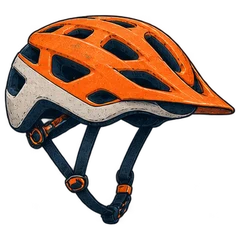
Every maker's size for your head
Each maker's own chart for your head, side by side. Where they disagree, the result above is the size most of them share.
Enter your head circumference above to see each maker's size.
Popular 2026 bike helmets in your size
The size of each popular helmet that fits your head, from that maker's chart for the model, with a link to check prices.
Enter your head circumference above to see your size in each popular helmet.
Check the helmet you have
Pick the maker and size of a helmet you already have to see whether it fits the head size above.
Shop this size
Enter your head circumference above to get shopping links for your helmet size.
Affiliate links. We may earn a commission at no cost to you. See the disclosure.How to measure your head
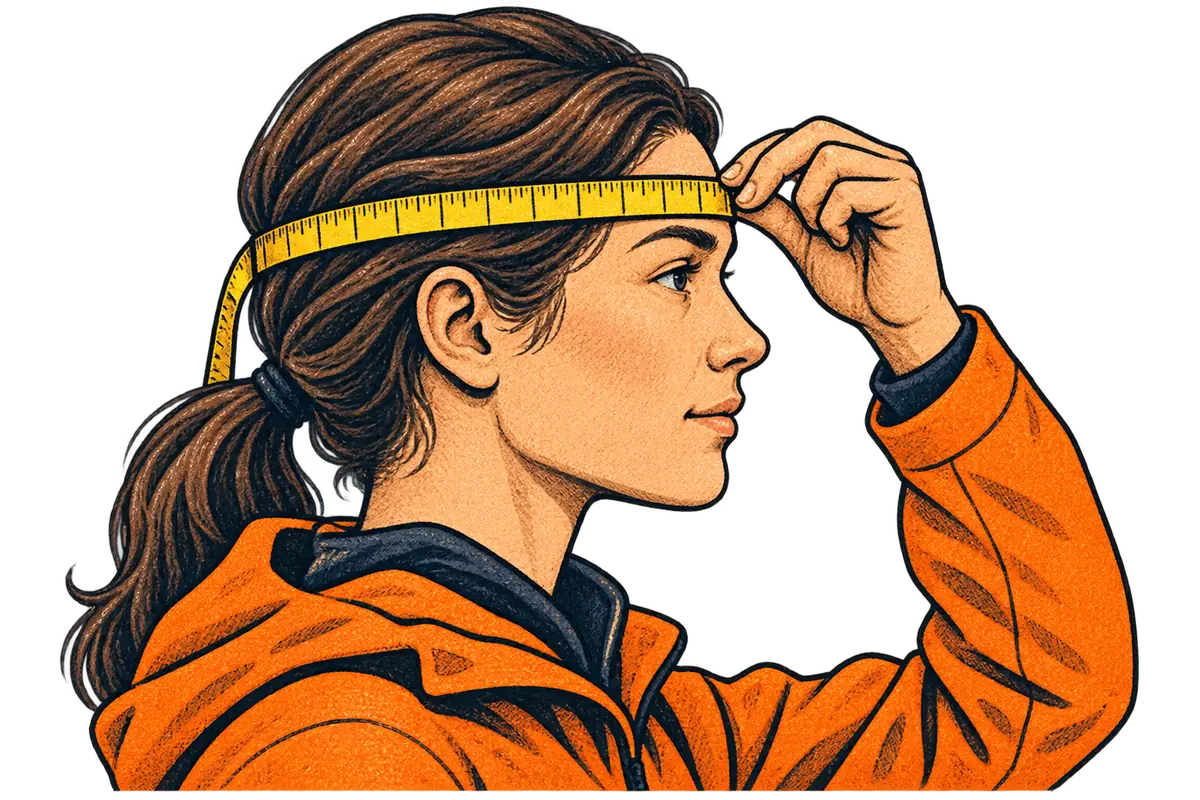
- Use a flexible tape measure, or a string and a ruler.
- Wrap it around the largest part of your head, about 1 inch (2.5 cm) above your eyebrows, level and snug but not tight.
- Measure twice and use the larger number (Bell).
Bike helmet size chart by head circumference Printable card (PDF)
Bike helmets are sized by the circumference of your head in centimetres. Every maker's sizes cover a similar range, but the steps differ: most print S, M and L, Trek and Lazer add S/M or M/L, and Thousand's Small starts at 54 cm. This table reads across from a head size to the adult size each maker's chart gives.
| Head size | Giro | Bell | Trek | Specialized | POC | Smith | Kask | Lazer | Fox | Thousand | Nutcase |
|---|---|---|---|---|---|---|---|---|---|---|---|
| 50 cm (19.7 in) | — | — | — | — | S | XS | S | — | — | — | — |
| 51 cm (20.1 in) | S | — | S | S | S | XS or S | S | — | S | — | — |
| 52 cm (20.5 in) | S | S | S | S | S | XS or S | S or M | S | S | — | S |
| 53 cm (20.9 in) | S | S | S | S | S | S | S or M | S | S | — | S |
| 54 cm (21.3 in) | S | S | S or M | S | S or M | S | S or M | S | S | S | S |
| 55 cm (21.7 in) | S or M | S or M | S or M | S or M | S or M | S or M | S or M | S or M | S or M | S | S |
| 56 cm (22.0 in) | M | S or M | S or M | S or M | S or M or L | M | S or M | S or M | M | S | S or M |
| 57 cm (22.4 in) | M | M | S or M | M | M or L | M | M | M | M | S or M | M |
| 58 cm (22.8 in) | M | M or L | M or L | M | M or L | M | M | M or L | M | M | M |
| 59 cm (23.2 in) | M or L | M or L | M or L | M or L | M or L | M or L | L | M or L | M or L | M or L | M |
| 60 cm (23.6 in) | L | L | M or L or XL | M or L | M or L | L | L | L | L | L | M or L |
| 61 cm (24.0 in) | L | L or XL | L or XL | L | L | L or XL | L | L or XL | L | L | L |
| 62 cm (24.4 in) | L | L or XL | L or XL | L | L | L or XL | L | XL | L | L | L |
| 63 cm (24.8 in) | L or XL | XL | L or XL | — | — | XL | — | XL | L | — | L |
| 64 cm (25.2 in) | XL | XL | XL | — | — | XL | — | XL | — | — | L |
| 65 cm (25.6 in) | XL | XL | XL | — | — | XL | — | — | — | — | — |
— means outside that maker's adult range. Trek and Lazer also make some helmets in S/M or M/L; those ranges are in the next table. Smith's adult XS starts at 48 cm and Trek's XL goes to 66 cm. Inch values are converted from the centimetres each source gives.
Every maker's bike helmet sizes
Each maker's chart as printed. Giro, Bell, Trek, Specialized, Smith and Fox are from the maker's own site; POC, Kask and Lazer are the maker's chart as copied by a retailer (99 Bikes, Alpinstore and Bergfreunde); Nutcase and Thousand are from Public Bikes, which sells both. Bell prints a chart for each model, and the one shown is shared by the Sixer, 4Forty, XR Spherical, Local and 5Fifty.
| Maker | Adult sizes (head circumference) | Kids' sizes | Chart |
|---|---|---|---|
| Giro | S 51–55 · M 55–59 · L 59–63 · XL 63–65 cm; one size: Universal Adult 54–61 · Universal Women's 50–57 · Universal X-Large 58–65 cm | Youth XS 45–51 · Youth S 49–55 · Universal Child 47–54 · Universal Youth 50–57 cm | Maker's chart |
| Bell | S 52–56 · M 55–59 · L 58–62 · XL 61–65 cm | Universal Toddler 45–52 · Universal Child 48–55 · Universal Youth 50–57 cm | Maker's chart |
| Trek | S 51–57 · S/M 51–58 · M 54–60 · M/L 55–61 · L 58–63 · XL 60–66 cm | Toddler 46–50 · Child 48–52 · Youth / XS 50–55 cm | Maker's chart |
| Specialized | S 51–56 · M 55–60 · L 59–62 cm | — | Maker's chart |
| POC | S 50–56 · M 54–60 · L 56–62 cm | — | 99 Bikes' copy |
| Smith | XS 48–52 · S 51–55 · M 55–59 · L 59–62 · XL 61–65 cm | Youth S 48–52 cm | Maker's chart |
| Kask | S 50–56 · M 52–58 · L 59–62 cm | — | Alpinstore's copy |
| Lazer | S 52–56 · M 55–59 · M/L 55–61 · L 58–61 · XL 61–64 cm | Bob+ (toddler) 46–52 · Max+ (kids) 50–56 cm | Bergfreunde's copy |
| Fox | S 51–55 · M 55–59 · L 59–63 cm | — | Maker's chart |
| Thousand | S 54–57 · M 57–59 · L 59–62 cm | Jr. (XS) 49–53 cm | Public Bikes' list |
| Nutcase | S 52–56 · M 56–60 · L 60–64 cm | — | Public Bikes' list |
| REI (general guide) | XS under 51 · S 51–55 · M 55–59 · L 59–63 · XL over 63 cm | — | Any brand; not counted |
Kids' bike helmet size chart
Kids' sizes go by many names, and the same name can mean different things: Smith's Youth S (48 to 52 cm) is the same range as Trek's Child, while Giro's Youth S runs 49 to 55 cm. The last column sorts each size by the middle of its range. Toddler sizes run about 45 to 52 cm, child sizes about 47 to 55 and youth sizes about 49 to 57. Go by the centimetres printed for the helmet.
| Maker | Kids' size | Head size | Inches | Sized like |
|---|---|---|---|---|
| Giro | Youth XS | 45–51 cm | 17.7–20.1 in | Toddler |
| Bell | Universal Toddler | 45–52 cm | 17.7–20.5 in | Toddler |
| Trek | Toddler | 46–50 cm | 18.1–19.7 in | Toddler |
| Lazer | Bob+ (toddler) | 46–52 cm | 18.1–20.5 in | Toddler |
| Giro | Universal Child | 47–54 cm | 18.5–21.3 in | Child |
| Smith | Youth S | 48–52 cm | 18.9–20.5 in | Child |
| Trek | Child | 48–52 cm | 18.9–20.5 in | Child |
| Bell | Universal Child | 48–55 cm | 18.9–21.7 in | Child |
| Thousand | Jr. (XS) | 49–53 cm | 19.3–20.9 in | Child |
| Giro | Youth S | 49–55 cm | 19.3–21.7 in | Youth |
| Trek | Youth / XS | 50–55 cm | 19.7–21.7 in | Youth |
| Lazer | Max+ (kids) | 50–56 cm | 19.7–22.0 in | Youth |
| Bell | Universal Youth | 50–57 cm | 19.7–22.4 in | Youth |
| Giro | Universal Youth | 50–57 cm | 19.7–22.4 in | Youth |
The charts we compare for Specialized, POC, Kask, Fox and Nutcase list adult sizes only; Specialized says its kids' sizes are set model by model. Measure a child again each season.
How a helmet should fit
- Level and low. The front edge sits one inch or less above your eyebrows, not tilted back (REI, Trek).
- Snug, not tight. Push the helmet side to side and front to back; movement of an inch or more means adjust it (REI).
- Straps. They form a V under each ear (REI, Trek). Trek says only two fingers should fit between the chin strap and your chin.
- Mouth test. Buckle the strap and open your mouth wide. The helmet should press down on top of your head (REI).
Worked example
A rider wraps a tape around her head an inch above the eyebrows and reads 22.8 inches. Multiplying by 2.54 gives 57.9 cm. Reading across the chart above, all 11 makers list a Medium that fits: 55 to 59 cm at Giro, Bell, Smith, Lazer and Fox, 54 to 60 at Trek and POC, 55 to 60 at Specialized, 52 to 58 at Kask, 56 to 60 at Nutcase and 57 to 59 at Thousand. She is near the top of most of those ranges. POC's Large (56 to 62 cm) also fits her, and Bell's and Lazer's Large start at 58 cm, so if a Medium feels tight with the dial fully open, a Large from one of those makers is the next helmet to try.
Now a second rider who measures exactly 59.0 cm. REI puts the boundary between Medium and Large right there, and Giro does too. The REI advice is to choose the smaller size, so he tries the Medium first. With the retention wheel loose, the helmet should drop on without forcing it over the ears, and tightening the wheel should bring it snug. If it presses hard on the temples before the wheel is half-way, the Large is the better helmet, and the wheel will take up the slack. A tape reading only gets you to the right two sizes; the fit check settles which.
Set the helmet on your head
With the size chosen, the order of adjustment matters. Pads and the dial come first, then the straps, then the buckle.
- Loosen everything. Open the adjustment wheel fully if the helmet has one. REI starts here, then has you put the helmet on and twist the wheel until it is snug. Helmets without a wheel use interchangeable foam pads; choose the thickest set that still lets you put it on without force.
- Seat it level. The front edge should sit one inch or less above your eyebrows (REI), covering your forehead (Trek). Tilted back, it leaves the forehead bare. Pulled down too far, it blocks your view. The Bicycle Helmet Safety Institute adds that the helmet should sit as low on the head as possible for side coverage, and above the frame of your glasses if you wear them.
- Set the side straps. Slide the strap dividers so the straps meet just below each earlobe (Trek). REI describes the result as a V shape under each ear. The Bicycle Helmet Safety Institute calls the same junction a Y. The straps should lie flat against your head with no twists.
- Buckle and tighten the chin strap. Trek says you should be able to fit two fingers between your chin and the strap, and no more. Listen for the click when you buckle, and pull on the strap to confirm it holds.
- Tuck the tail. Fold the loose end through the strap keeper so it does not flap. Trek says that if you trim the strap, leave at least 1 inch (25 mm) past the buckle, and melt the cut end of the nylon so it does not fray, keeping the heat away from the helmet.
Three fit tests
The mouth test
With the strap buckled, open your mouth as wide as you can. REI says the helmet should press against the top of your head as you do. If it does not, tighten the chin strap a little and repeat, without overtightening.
The shake test
Push the helmet side to side and front to back. REI treats movement of an inch or more as a sign the fit needs adjusting. The Bicycle Helmet Safety Institute's version is more specific. Shake your head, then push the front edge up and back; if it moves more than about an inch from level, tighten the front strap. Pull up on the back edge; if it moves more than an inch, tighten the rear strap.
The slide test
Trek's check is to hold the helmet with the retention system fastened and try to move it forward and backward. It should not slide forward over your eyes or back to expose your forehead. If you cannot get it right, Trek says to take it to a local retailer.
Another worked example: sizing and adjusting a real head
Say your tape reads 22.2 inches. Multiply by 2.54 and you get 56.4 cm. Against the REI chart that is Medium (55-59 cm), comfortably inside the range. Against Trek's list it falls in Small (51-57), S/M (51-58), Medium (54-60) and M/L (55-61). The Medium is the best choice here because 56.4 sits close to the middle of 54-60, which leaves the dial room to move in both directions.
Strap creep and other things that loosen a helmet
A helmet that fit in the shop can loosen over a season. The Bicycle Helmet Safety Institute notes that helmets with non-locking side buckets can let the straps slide in use. Its suggestions are a snug rubber band under the buckle or about five or six stitches of heavy thread through the straps. Pads compress only slightly, so the same page says not to count on them to loosen the fit over time.
What the certification label tells you
In the United States, helmets sold for bicycling must meet the Consumer Product Safety Commission's standard, 16 CFR Part 1203. REI states that all helmets in the U.S. must meet the same standard for impact protection. According to the Bicycle Helmet Safety Institute's summary of the standard, peak acceleration in the impact tests may not exceed 300 g, and the drop tests use flat, hemispherical and curbstone anvils. The retention system is also tested: a 4 kg weight dropped from 0.6 m must not stretch it by more than 30 mm. A roll-off test checks that the helmet stays on the headform.
The certification label has to say the helmet "Complies with U.S. CPSC Safety Standard for Bicycle Helmets for Persons Age 5 and Older," or the "Age 1 and Older (Extended Head Coverage)" version for toddler helmets. The label also gives the month and year of manufacture, which is the date you need for the replacement rule below.
When to replace a helmet
| Situation | What the sources say |
|---|---|
| Any crash where the helmet took a hit | REI: assume a helmet involved in any accident is damaged, even if it looks fine. Bell: never wear a helmet that has been in an accident. The CPSC warning label says impacts can damage a helmet without visible signs. |
| Cracked foam, or a hard drop | Bicycle Helmet Safety Institute: cracks in the foam always require replacement. |
| Age with no crash | REI: replace after five years. Bell: generally every three years. Bicycle Helmet Safety Institute: many makers say five, Bell says three, and it suggests part of this may be marketing. |
| Sun damage to the shell | Bicycle Helmet Safety Institute: fading or small cracks around the vents suggest UV inhibitors are failing. |
| Sweat, hot car | Bicycle Helmet Safety Institute: sweat will not degrade the helmet; a hot car can affect the shell but not the foam. |
The age rule is where the sources disagree, and it is worth being clear about the reasoning. The foam in a bike helmet is built to absorb one impact. After that it has done its work, which is why the crash rule is the same everywhere. The five-year and three-year figures are manufacturer guidance about materials weathering. The Bicycle Helmet Safety Institute cites a 2015 MEA Forensic study of 675 helmets, some up to 26 years old, that found no significant loss of impact performance with age, and concludes that a helmet meeting ASTM or Snell standards, in good shape and fitting well, does not give a compelling case for replacement on age alone. Look at the manufacture date on the label, and decide against the maker's own advice.
How this chart is built
The calculator reads the bike helmet charts of 11 makers: Giro, Bell, Trek, Specialized, Smith and Fox from their own sites, POC, Kask and Lazer as copied by the retailers 99 Bikes, Alpinstore and Bergfreunde, and Nutcase and Thousand from Public Bikes, which sells both. Bell now prints a chart for each model instead of one table; we use the chart its Sixer, 4Forty, XR Spherical, Local and 5Fifty share. Each maker's sizes are kept separate instead of averaged, because the ranges overlap and a blended range would match no actual helmet.
For each maker, the calculator takes the size whose range is centred nearest your head; when two sizes are equally close, both count, and other sizes that also fit are listed beside it. For adults, the result is the letter size most makers land on, and a size that at least three quarters as many makers land on is shown too, so a head on a line between sizes gets both. A combined size counts for both letters: Trek's S/M counts as an S and an M. For kids, the size names differ too much to count, so each maker's kids' size is sorted into a toddler, child or youth size by the middle of its range (up to 49 cm, under 52 cm, or 52 cm and up), and the result is the group most makers land on. REI's general guide and one-size helmets are shown but not counted.
The popular 2026 helmets list each model's own sizes, from the maker's chart for that model or the maker's general chart where the model uses it. Where a source gives centimetres only, the inch values are our conversion, rounded to a tenth. Last checked November 16, 2026.
Questions
How do I measure my head for a bike helmet?
Wrap a flexible tape measure around the largest part of your head, about one inch (2.5 cm) above your eyebrows, level from front to back and snug but not tight (REI, Bell). Measure twice and use the larger reading (Bell). With no tape, wrap a string around your head and measure it against a ruler (REI).
What if I am between two helmet sizes?
The sources disagree. REI says to choose the smaller size, Public Bikes says to choose the larger one for Nutcase and Thousand helmets, and Smith suggests trying both on at a shop. Try both on if you can: the helmet should sit level and snug without moving more than about an inch when you push it.
What size bike helmet is 56 cm?
Medium, for most makers. 56 cm is inside the Medium at 10 of the 11 makers we compare (Giro, Bell, Trek, Specialized, POC, Smith, Kask, Lazer, Fox and Nutcase); Thousand calls it a Small (54 to 57 cm). It is also the very top of the Small at Bell, Specialized, POC, Kask, Lazer and Nutcase. Giro's advice is that a helmet should fit with a little room when the fit system is loose, so at 56 cm the Medium is usually the better choice.
Are bike helmet sizes the same for every brand?
No. REI notes that values vary slightly among brands, and the charts above show it: a 53 cm head is a Small at most makers, but it is also inside Kask's Medium (52 to 58 cm), and Thousand's adult Small starts at 54 cm, so at Thousand it needs the Jr. (49 to 53 cm). Always check the head range printed for the specific helmet.
What is the difference between toddler, child and youth helmet sizes?
They are kids' size names, and they overlap. Toddler sizes run about 45 to 52 cm (Bell Universal Toddler 45 to 52, Trek Toddler 46 to 50, Lazer Bob+ 46 to 52), child sizes about 47 to 55 cm (Giro Universal Child 47 to 54, Bell Universal Child 48 to 55, Trek Child 48 to 52) and youth sizes about 49 to 57 cm (Giro and Bell Universal Youth 50 to 57, Trek Youth 50 to 55, Lazer Max+ 50 to 56). The names are not consistent: Smith's Youth S, 48 to 52 cm, is the same range as Trek's Child. Go by the centimetres.
What head size does a one-size bike helmet fit?
Most adult one-size helmets fit about 54 to 61 cm: Giro's Universal Adult and Lazer's Codax both list 54 to 61 cm. Giro also makes a Universal Women's (50 to 57 cm) and a Universal X-Large (58 to 65 cm). A one-size helmet relies on its fit system to take up the difference, so check the range printed for the model.
How tight should a bike helmet chin strap be?
Trek says you should be able to fit only two fingers between your chin and the strap. The Bicycle Helmet Safety Institute describes it as comfortably snug without cutting into the chin. Do the mouth test: when you open wide, the helmet should press down on top of your head.
Should a bike helmet sit on my forehead?
It should sit level, with the front edge one inch or less above your eyebrows (REI). If you can see the front rim in your upper vision or the helmet rocks back and exposes your forehead, tighten the front strap and lower the helmet.
Do I need a new helmet if I dropped mine?
Not necessarily. The Bicycle Helmet Safety Institute says cracks in the foam always require replacement and that any helmet dropped on a hard surface should be inspected for them. A helmet that took a real impact on your head should be replaced even if it looks intact.
Can I use a kids' helmet if I have a small head?
REI says some adults with smaller heads can wear a kids' size. Go by the head range printed for the specific helmet and confirm the certification label says it meets the CPSC standard.
Related charts
 Bike size chartAdult road, gravel and mountain frame size
Kids bike size chartWheel size from inseam, height and age
All bike sizingAdult and kids bike charts
 Ski helmet size chartHead size to ski helmet size
- Giro, Bike Helmet Size Guide (adult, universal and youth sizes)
- Bell, size charts by model
- Trek, How to Fit a Bike Helmet Correctly for Safety
- Specialized, How do I know what size helmet fits me?
- POC helmet size chart, as published by 99 Bikes
- Smith, The Only Bike Helmet Buying Guide You Need
- Kask helmet sizes by model group, as published by Alpinstore
- Lazer size charts, as published by Bergfreunde
- Fox, Speedframe helmet size chart
- Public Bikes, helmet size recommendations (Nutcase and Thousand)
- REI, How to choose bike helmets (checked October 9, 2026)
- Bicycle Helmet Safety Institute, helmet fit (checked October 9, 2026)
- Bicycle Helmet Safety Institute, when to replace a helmet (checked October 9, 2026)
- Bicycle Helmet Safety Institute, CPSC bicycle helmet standard summary (16 CFR Part 1203) (checked October 9, 2026)
- Bell, product FAQ (crash replacement and replacement interval) (checked October 9, 2026)