
Bike helmet fit: measuring your head, adjusting the straps, and when to replace it
A helmet only works if it stays where it belongs on your head. That depends on picking the right size from a tape measurement, then setting the pads and straps so the helmet sits level and does not shift. This guide covers the measurement, the adjustment order, three quick tests, and the point at which a helmet has to go in the bin.
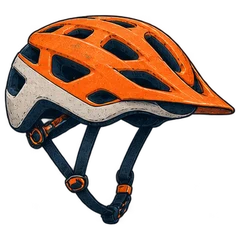
Measure your head first
You need a flexible tape measure. If you only have a rigid one, use a piece of string and lay it against a ruler afterward; REI suggests exactly that. Wrap the tape around the largest part of your head, about one inch (2.5 cm) above your eyebrows, as REI describes it. Giro adds that the tape should stay level from the front of your head to the back, so check in a mirror that it does not dip at the nape of your neck.
Read the number in centimetres if you can, because helmet makers print their ranges in centimetres. A reading of 22.4 inches, for example, is 56.9 cm. Take the measurement two or three times. Hair volume and how hard you pull the tape will move the number by a few millimetres, and that matters when a size boundary sits at 55 or 59.
Turn the number into a size
There is no single standard for what Small or Medium means. REI says plainly that brand sizing varies and that you should check the head circumference listed for the specific size you are considering. Here are two charts side by side, REI's general guide and the sizes Trek publishes for its own helmets.
| Head circumference | REI size | Trek sizes that cover it |
|---|---|---|
| 50 cm (19.7 in) | Extra small (under 51 cm) | Toddler 46-50, Child 48-52, Youth/XS 50-55 |
| 53 cm (20.9 in) | Small (51-55 cm) | Child 48-52 ends just short; Youth/XS 50-55, Small 51-57, S/M 51-58 |
| 55 cm (21.7 in) | Small or Medium (shared edge) | Youth/XS, Small, S/M, Medium 54-60, M/L 55-61 |
| 57 cm (22.4 in) | Medium (55-59 cm) | Small, S/M, Medium, M/L |
| 60 cm (23.6 in) | Large (59-63 cm) | Medium, M/L, Large 58-63, X-Large 60-66 |
| 64 cm (25.2 in) | Extra large (over 63 cm) | X-Large 60-66 |
The Trek ranges overlap heavily. A 57 cm head sits inside four different Trek sizes. That is deliberate: in an overlapping range, the helmet relies on its adjustment system to take up the difference, so the size you land on is partly a question of which end of the range you want to be at. Landing near the middle of a range leaves the fit dial room to move either way.
REI also notes that some adults with smaller heads can wear a kids' size. A 50 cm adult head fits the Trek Youth/XS (50-55 cm) at its lower edge, for example. Check the label inside for the CPSC statement and the age it covers.
Set the helmet on your head
With the size chosen, the order of adjustment matters. Pads and the dial come first, then the straps, then the buckle.
- Loosen everything. Open the adjustment wheel fully if the helmet has one. REI starts here, then has you put the helmet on and twist the wheel until it is snug. Helmets without a wheel use interchangeable foam pads; choose the thickest set that still lets you put it on without force.
- Seat it level. The front edge should sit one inch or less above your eyebrows (REI), covering your forehead (Trek). Tilted back, it leaves the forehead bare. Pulled down too far, it blocks your view. The Bicycle Helmet Safety Institute adds that the helmet should sit as low on the head as possible for side coverage, and above the frame of your glasses if you wear them.
- Set the side straps. Slide the strap dividers so the straps meet just below each earlobe (Trek). REI describes the result as a V shape under each ear. The Bicycle Helmet Safety Institute calls the same junction a Y. The straps should lie flat against your head with no twists.
- Buckle and tighten the chin strap. Trek says you should be able to fit two fingers between your chin and the strap, and no more. Listen for the click when you buckle, and pull on the strap to confirm it holds.
- Tuck the tail. Fold the loose end through the strap keeper so it does not flap. Trek says that if you trim the strap, leave at least 1 inch (25 mm) past the buckle, and melt the cut end of the nylon so it does not fray, keeping the heat away from the helmet.
Three fit tests
The mouth test
With the strap buckled, open your mouth as wide as you can. REI says the helmet should press against the top of your head as you do. If it does not, tighten the chin strap a little and repeat, without overtightening.
The shake test
Push the helmet side to side and front to back. REI treats movement of an inch or more as a sign the fit needs adjusting. The Bicycle Helmet Safety Institute's version is more specific. Shake your head, then push the front edge up and back; if it moves more than about an inch from level, tighten the front strap. Pull up on the back edge; if it moves more than an inch, tighten the rear strap.
The slide test
Trek's check is to hold the helmet with the retention system fastened and try to move it forward and backward. It should not slide forward over your eyes or back to expose your forehead. If you cannot get it right, Trek says to take it to a local retailer.
Worked example: sizing and adjusting a real head
Say your tape reads 22.2 inches. Multiply by 2.54 and you get 56.4 cm. Against the REI chart that is Medium (55-59 cm), comfortably inside the range. Against Trek's list it falls in Small (51-57), S/M (51-58), Medium (54-60) and M/L (55-61). The Medium is the best choice here because 56.4 sits close to the middle of 54-60, which leaves the dial room to move in both directions.
Strap creep and other things that loosen a helmet
A helmet that fit in the shop can loosen over a season. The Bicycle Helmet Safety Institute notes that helmets with non-locking side buckets can let the straps slide in use. Its suggestions are a snug rubber band under the buckle or about five or six stitches of heavy thread through the straps. Pads compress only slightly, so the same page says not to count on them to loosen the fit over time.
What the certification label tells you
In the United States, helmets sold for bicycling must meet the Consumer Product Safety Commission's standard, 16 CFR Part 1203. REI states that all helmets in the U.S. must meet the same standard for impact protection. According to the Bicycle Helmet Safety Institute's summary of the standard, peak acceleration in the impact tests may not exceed 300 g, and the drop tests use flat, hemispherical and curbstone anvils. The retention system is also tested: a 4 kg weight dropped from 0.6 m must not stretch it by more than 30 mm. A roll-off test checks that the helmet stays on the headform.
The certification label has to say the helmet "Complies with U.S. CPSC Safety Standard for Bicycle Helmets for Persons Age 5 and Older," or the "Age 1 and Older (Extended Head Coverage)" version for toddler helmets. The label also gives the month and year of manufacture, which is the date you need for the replacement rule below.
When to replace a helmet
| Situation | What the sources say |
|---|---|
| Any crash where the helmet took a hit | REI: assume a helmet involved in any accident is damaged, even if it looks fine. Bell: never wear a helmet that has been in an accident. The CPSC warning label says impacts can damage a helmet without visible signs. |
| Cracked foam, or a hard drop | Bicycle Helmet Safety Institute: cracks in the foam always require replacement. |
| Age with no crash | REI: replace after five years. Bell: generally every three years. Bicycle Helmet Safety Institute: many makers say five, Bell says three, and it suggests part of this may be marketing. |
| Sun damage to the shell | Bicycle Helmet Safety Institute: fading or small cracks around the vents suggest UV inhibitors are failing. |
| Sweat, hot car | Bicycle Helmet Safety Institute: sweat will not degrade the helmet; a hot car can affect the shell but not the foam. |
The age rule is where the sources disagree, and it is worth being clear about the reasoning. The foam in a bike helmet is built to absorb one impact. After that it has done its work, which is why the crash rule is the same everywhere. The five-year and three-year figures are manufacturer guidance about materials weathering. The Bicycle Helmet Safety Institute cites a 2015 MEA Forensic study of 675 helmets, some up to 26 years old, that found no significant loss of impact performance with age, and concludes that a helmet meeting ASTM or Snell standards, in good shape and fitting well, does not give a compelling case for replacement on age alone. Look at the manufacture date on the label, and decide against the maker's own advice.
Questions
How tight should a bike helmet chin strap be?
Trek says you should be able to fit only two fingers between your chin and the strap. The Bicycle Helmet Safety Institute describes it as comfortably snug without cutting into the chin. Do the mouth test: when you open wide, the helmet should press down on top of your head.
Should a bike helmet sit on my forehead?
It should sit level, with the front edge one inch or less above your eyebrows (REI). If you can see the front rim in your upper vision or the helmet rocks back and exposes your forehead, tighten the front strap and lower the helmet.
Do I need a new helmet if I dropped mine?
Not necessarily. The Bicycle Helmet Safety Institute says cracks in the foam always require replacement and that any helmet dropped on a hard surface should be inspected for them. A helmet that took a real impact on your head should be replaced even if it looks intact.
Can I use a kids' helmet if I have a small head?
REI says some adults with smaller heads can wear a kids' size. Go by the head range printed for the specific helmet and confirm the certification label says it meets the CPSC standard.
Related tools
Bike helmet size chartHelmet size from head circumference
 Kids bike size chartWheel size from inseam and height
Bike size chartFrame size for adult bikes
Fitting a frame as well? See how to choose a bike frame size or how to size a kids' bike.
- REI, How to choose bike helmets
- Trek, How to fit a bike helmet
- Giro, size chart and measuring instructions
- Bicycle Helmet Safety Institute, helmet fit
- Bicycle Helmet Safety Institute, when to replace a helmet
- Bicycle Helmet Safety Institute, CPSC bicycle helmet standard summary (16 CFR Part 1203)
- Bell, product FAQ (crash replacement and replacement interval)