
Ski boot fit guide: Mondopoint, shell size, last width and flex
A ski boot has four numbers that matter: the Mondopoint size on the tag, the shell size it is built on, the width of the last, and the flex rating. Most bad boot purchases come from treating the first one as the whole story. This guide explains what each number means, how brands disagree, and how to check the fit with a bare shell and a ruler.
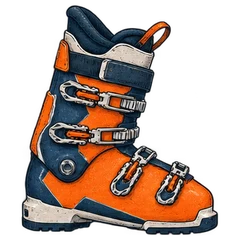
Mondopoint is a foot length, not a shell
Mondopoint is your foot length in centimetres. Mondopoint is an international system built on foot length in millimetres, so a 26.5 cm foot is a size 26.5 and a 265 mm foot is the same thing (Carv). That makes it the one number every brand shares, and it is why a street shoe size is only a starting guess. evo says a shoe-size conversion "works in a pinch" but is less accurate than measuring. Jans goes further and does not recommend converting a shoe size at all. If you have not measured your foot yet, do that first with the home measuring guide.
The trouble is that a Mondopoint tag on a boot does not mean the inside of the boot is that long. Brands build to different tolerances, so the same foot lands on different numbers depending on how the brand converts shoe sizes. For a US men's 10, Nordica's standard fit is 28 and its performance fit is 27 (Surefoot, reproducing Nordica's chart). evo's chart gives 28.5 for comfort and 27.5 for performance. Our ski boot size chart lines up these brand differences side by side.
Shell size is the part you cannot change
Boot makers do not build a separate shell for every half size. Carv puts it plainly: "the size of the shell actually doesn't change between a 25 (250mm) and a 25.5 (255mm)." Jans says whole and half sizes often share a shell, with the differences in the liner. Peter Glenn describes shells in whole sizes (26, 27, 28) with liners making up the half sizes through thickness changes.
Carv groups shells into letter sizes, which shows how wide each shell band is:
| Shell | Mondopoint range it covers (Carv) |
|---|---|
| D | 22.0 to 24.5 |
| E | 25.0 to 27.5 |
| F | 28.0 to 30.5 |
Brands cut their shell bands differently, and the Carv grouping is one example, not a standard. The point is what it does to you. A skier at 27.5 in one brand and a skier at 28.0 in the same brand may be choosing between two different shells, and the shell is what a bootfitter cannot easily resize. Carv and Jans both advise that when you fall between two sizes you take the smaller one. Jans gives the reason: the liner packs out over time, a fitter can widen key areas of the shell, and a boot that is too big is much harder to fix.
Comfort fit and performance fit
Fit style is how far below your measured length the boot is sized. evo describes comfort fit as roomier, suited to beginners and intermediates who ski a few times a season on groomed terrain at moderate speeds. Performance fit suits intermediate to advanced skiers on varied terrain at speed. Nordica's guidance matches: performance fit for intermediate-to-advanced skiers who ski regularly, standard fit for beginner-to-intermediate skiers who ski less often.
| Skier | Suggested size relative to your Mondopoint | Source |
|---|---|---|
| Beginner to intermediate | Close to your measurement or slightly larger | evo |
| Intermediate to advanced | Close to or slightly smaller, in a stiffer flex | evo |
| Advanced to expert | Up to a full size smaller, with a stiff or very stiff flex; usually needs a skilled bootfitter | evo |
evo warns that "the tighter the fit, the more control you will have over your skis," but that tighter fits can also cause pressure points and pain. Carv offers a practical tiebreaker: if in doubt, go with the performance fit, because a fitter can stretch tight spots but cannot shrink a boot that is too big.
The shell check
This is the test that settles size, and it takes two minutes in a shop. Take the liner out, put your foot in the bare shell wearing a thin ski sock, and slide forward until your toes touch the front. Then look at the space behind your heel.
| Gap behind heel | What it means | Source |
|---|---|---|
| About 15 to 20 mm, one to two fingers | Roughly the standard range; tighter for stronger skiers | Surefoot |
| One finger, a little more than 1/4 inch | Performance fit | GearX |
| Two stacked fingers, about 3/4 inch | Comfort fit; GearX suggests it for cold-prone feet or boots without a heat-mouldable liner | GearX |
| No more than two fingers (comfort) or one finger (performance) | Carv's intermediate guidance | Carv |
Bend your knees with your heels down when you check the gap, as GearX describes, because a standing gap overstates the room. Surefoot adds two more checks: your heel should stay down when you flex forward, and your foot should not press into the sides when you stand tall.
Once the liner is back in, buckle the boot to skiing tightness. Ideally your toes lie flat against the front of the liner (GearX). Peter Glenn describes a performance fit as toes lightly touching when you stand and pulling back slightly in the skiing position. If you have to bottom out the buckles to get the boot snug, GearX says the boot may have too much volume and a lower-volume model may suit you better.
Last width in millimetres
Last width is the width of the boot at the ball of the foot, quoted in millimetres for a sample size. Three sources give three slightly different bands:
| Width | evo (Greg Louie) | Carv | Peter Glenn |
|---|---|---|---|
| Narrow | 97 mm and up | 97 to 100 mm | 97 to 98 mm |
| Medium | around 100 mm (average) | 100 to 102 mm | 99 to 101 mm |
| Wide | 102 mm and above | over 102 mm | 102 mm and above |
The boundaries overlap by a millimetre or two, so a boot listed at 100 mm is "medium" in all three but a 101 mm boot could be called medium or wide-ish depending on who is talking. Use the numbers to compare boots with each other, not to label your foot. Carv shows how to measure yours: mark the widest point on your foot on the paper and measure from the paper's edge to that mark. evo says last width depends mostly on foot structure and that advanced skiers typically pick narrower lasts for a snug fit. Jans notes that lasts differ between models, so a Salomon 27.5 can fit quite differently from a Tecnica 27.5.
If the boot is painful across the forefoot but the length is right, the answer is a wider last or a bootfitter's punch on the shell, not a longer boot. Going longer to fix width is the usual way people end up with heel lift.
Flex by ability
Flex index is a stiffness rating. A higher number means a stiffer boot with more power transfer but less forgiveness, according to K2. K2's bands:
| Flex | Men's index | Women's index | Skier (K2) |
|---|---|---|---|
| Soft | below 85 | below 75 | Beginners or leisurely groomed runs |
| Medium | 90 to 110 | 80 to 95 | Intermediates wanting more response |
| Stiff | above 115 | above 100 | Advanced skiers, steep terrain, high speed |
K2's table leaves gaps, such as 85 to 90 for men, and other sources use different numbers. Carv's guidance for casual male skiers is 80 to 110 and for aggressive male skiers 120 and up; for casual female skiers 60 to 80 and for aggressive female skiers 80 and up. Fischer says women's boots typically have a slightly lower flex index, and gives only qualitative bands (low to mid for all-around skiing, mid to high for serious frontside or freeride, hard to very hard for racing). Carv also notes that boots flex more in a warm shop and stiffen in cold mountain air, so a boot that feels right at room temperature will feel stiffer on the hill.
Worked example: a 27.0 cm foot
Say your longest foot measures 27.0 cm standing in a ski sock, and you are an intermediate who skis 10 to 15 days a year. Your Mondopoint is 27.0. Under evo's table, an intermediate-to-advanced skier takes a size close to or slightly smaller, so the realistic candidates are 26.5 and 27.0. A skier who skis rarely would look at 27.0 or 27.5.
Now the shell check. You try a 27.0 and a 26.5 from the same brand. They may share a shell, in which case the difference is the liner, and the bare-shell gap will be identical. If the 27.0 shows two fingers behind the heel and the 26.5 uses the same shell, the shell is on the roomy side for you and you should look at the next shell down, or a lower-volume model. If the gap is one finger, you have a performance fit, and the choice between 26.5 and 27.0 comes down to toe feel in the liner. Because liners pack out, and Peter Glenn puts that at 3 to 5 mm after break-in, a boot that is snug on day one is where you want to start.
Questions
Is Mondopoint the same as my foot length?
Yes, it is foot length in centimetres, so a 26.5 cm foot is a 26.5 (Carv, evo). The boot itself can be built differently, which is why the shell check matters as much as the number on the tag.
Should I measure both feet?
Sources split. Surefoot and Peter Glenn say to use the longer foot. Jans suggests sizing to the smaller one. A shell check on both feet in the actual boot settles it, and a fitter can stretch the shell for the larger foot.
What gap should I have behind my heel?
Surefoot gives about 15 to 20 mm for the bare-shell check, one to two fingers. GearX describes one finger as performance fit and two as comfort fit. Heel gap in the shell is a different thing from heel lift when skiing, which means the boot is too big.
What flex should I buy?
K2 puts medium flex at 90 to 110 for men and 80 to 95 for women, with soft below 85 and 75 and stiff above 115 and 100. Pick the band for your ability, then let fit decide among boots in it.
Related tools
Ski boot size chartShoe size to Mondopoint, by brand
Measure your footHome method for ski and snowboard boots
 Ski size calculatorSki length from height, weight and ability
- evo, Ski Boot Size Chart and Mondopoint Conversion
- K2, How to Choose Ski Boots
- Surefoot, Ski Boot Sizing Guide
- Carv, Ski Boot Size Chart and Mondopoint Size Guide
- GearX, How to Size Ski Boots
- Jans, Mondopoint Sizing Explained
- Peter Glenn, Understanding Mondopoint Sizing
- Fischer, Ski Boots: Fit Well, Ski Well