
Baseball glove size guide
Glove size is a length in inches, stamped on the thumb or little finger, and the right number depends on position first and age second. Hand fit decides between two gloves of the same size. This guide covers the sizes, the checks, and how to break a glove in.
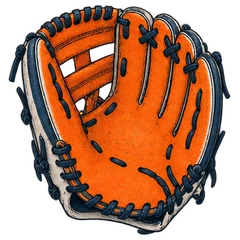
How a glove is measured
Fielding gloves are measured from the tip of the index finger, down the palm side, to the heel of the glove. BaseballMonkey says sizes are usually stamped on the thumb or pinky finger and run from 8 to 15 inches, and that without a stamp you can run a fabric tape from the top of the index finger to the center of the heel. Catcher's mitts and first base mitts are different. A catcher's mitt is measured around its circumference, which is why the numbers look huge: BaseballMonkey puts baseball catcher's mitts at 29.5 to 34.5 inches and softball ones at 29.5 to 35.
Baseball glove size by position and age
This is BaseballMonkey's baseball chart, the same one behind our baseball glove size chart. Sizes are inches; the catcher column is circumference.
| Age | Catcher | 1B | 2B / SS | 3B | Pitcher | Outfield |
|---|---|---|---|---|---|---|
| Under 7 | 29.5 to 30 | 11.5 | 8 to 10.5 | 8 to 10.5 | 8 to 10.5 | 9 to 10.5 |
| 8 to 10 | 30 to 31 | 11.5 to 12 | 10.5 to 11.25 | 10.5 to 11.5 | 10.5 to 11.5 | 10 to 12 |
| 11 to 13 | 30 to 32.5 | 11.5 to 12 | 11 to 11.5 | 11 to 11.75 | 11.5 to 12 | 11.75 to 12.75 |
| 14 and over | 32 to 34.5 | 12 to 13 | 11.25 to 11.5 | 11.5 to 12 | 11.5 to 12 | 12 to 13 |
Other makers publish slightly different numbers, and the differences are worth knowing. Wilson lists youth infield gloves at 10.75 to 11.5 inches for ages 8 to 10 and 11 to 11.75 for ages 11 to 12, with adult infield gloves at 11 to 12. Scheels lists an adult infield glove at 11 to 12.25 and an adult outfield glove at 12.5 to 12.75. Scheels' fastpitch guide gives high school and adult infield and pitcher gloves as 11.5 to 12.5 and outfield as 12.5 to 13. Those sources do not agree with each other, so treat each range as a zone, not a rule.
Softball sizes run a little larger
Fastpitch ranges run a little larger than baseball at the older ages, mostly in the infield. BaseballMonkey's fastpitch chart:
| Age | Catcher | 1B | 2B / SS | 3B | Pitcher | Outfield |
|---|---|---|---|---|---|---|
| Under 7 | 29.5 to 30 | 11.5 | 8 to 10.5 | 8 to 10.5 | 8 to 10.5 | 9 to 11 |
| 8 to 10 | 30 to 32 | 11.5 to 12 | 10.5 to 11.25 | 10.5 to 11.5 | 10.5 to 11.5 | 10 to 12 |
| 11 to 13 | 31 to 32.5 | 12 to 13 | 11.25 to 12 | 11.75 to 12.5 | 11.5 to 12.5 | 11.75 to 12.5 |
| Over 14 | 33 to 35 | 12 to 13 | 11.5 to 12.5 | 11.75 to 12.5 | 11.5 to 12.5 | 12 to 13 |
Slowpitch gloves are bigger again, by position only: BaseballMonkey lists first base at 12 to 13, infield 11.5 to 12.5, third base 11.75 to 13 and outfield 12 to 15. Wilson's slowpitch figures for players 13 and over are 12.5 to 13 in the infield and 13 to 14 in the outfield.
Why position changes the size
The charts put outfield gloves longer than infield gloves at every age. BaseballMonkey describes outfielders with deeper pockets and middle infielders with shallower ones. Webs follow the same logic. Scheels says infielders usually use an I-web or H-web, outfielders an H-web or trapeze, and pitchers a basket or two-piece web. Wilson adds that pitcher gloves use a closed web to hide the grip on the ball, and that first base mitts have a reinforced web.
Worked example: a 10-year-old who plays shortstop
The BaseballMonkey table gives 10.5 to 11.25 inches for ages 8 to 10 at second base or shortstop. Wilson says 10.75 to 11.5 for the same age and an infield glove. The overlap is 10.75 to 11.25. A glove stamped 11 inches sits in the middle of that overlap. If the child is small for ten, 10.75 is the safer end. A 10-year-old who is tall and has played a couple of seasons can try 11.25.
Now the hand. Wilson gives two checks. Squeeze test: if the player can easily close the glove, it is usable; if closing it is a struggle, go smaller. Slide test: with the arm hanging at the side, if the glove slides off, the glove or its hand opening is too big. A glove that passes both at 11 inches is the right glove, whatever the chart says.
Youth or adult, and the 12 to 14 gap
BaseballMonkey says youth gloves suit players under 10, and some players can use them to age 12, after which adult gloves are recommended. Wilson's youth sizes stop at 12 and its adult sizes start at 13, while BaseballMonkey puts the switch after 12. A 13-year-old falls between, so try both. For a smaller hand in an adult glove, BaseballMonkey notes the back of the wrist can be tightened: softball gloves have a Velcro strap, and baseball gloves need re-lacing. Wilson's Pedroia Fit gloves use a smaller wrist opening and shorter finger stalls for smaller hands.
Wilson's advice for younger players is a smaller glove, which it says gives more control, so buying a size up to grow into is working against the fit.
Leather decides how much break-in you face
Scheels describes three tiers. Premium leather is the most durable and best performing but harder to break in, and Scheels says premium gloves can last 10 to 15 years. Mid-grade is slightly easier. Entry-level or synthetic is easiest and lightest. BaseballMonkey adds that treated leather comes preconditioned with oils for a faster break-in, and synthetic gloves are the lightest and cheapest, aimed at younger players. Wilson says its youth baseball and youth fastpitch gloves use game-ready materials with little to no break-in.
Catcher's mitts are the stiffest. BaseballMonkey notes they take a while to break in, so many catchers buy a replacement a few months before the old one wears out.
How to break in a glove
The slow method is also the safest: play catch, squeeze the glove around the ball, repeat. BaseballMonkey calls it the most time-consuming and the lowest-risk. For a faster result, Wilson's seven steps are:
- Pour warm water into the palm with the fingers pointing up, so it doesn't soak the finger stalls. Wilson says warm, not boiling.
- Hold the glove by the thumb and pinkie and flex the heel pad back and forth.
- Pull the tops of the pinkie and thumb in opposite directions to stretch the top.
- Decide whether you want a deep or shallow pocket, open the glove on a sturdy surface and pound where the pocket should be with a mallet.
- Pound the thumb side above the wrist opening, flip it, and repeat on the pinkie side, which makes break points for opening and closing.
- Fold the web into an S shape and compress it for five to ten seconds to loosen the top laces.
- Play catch and repeat any step on the parts that still feel stiff.
BaseballMonkey disagrees on water; it tells readers to skip water and sun and to use a glove mallet, or an old baseball, on the pocket and the back. It also describes steaming at a shop, and wrapping the glove folded around a ball (a softball for softball players) tied with a glove wrap or old laces. If you do oil it, use only what the maker recommends, in a light coat.
What to avoid, per BaseballMonkey: a microwave or oven dries the leather and makes the laces brittle, and left unattended can start a fire. A hot car does similar damage. Vaseline, petroleum jelly, olive oil, mink oil and linseed oil are on its do-not-use list. Some unorthodox methods also void the warranty.
Questions
What size glove for a 12 year old?
It depends on position. BaseballMonkey's 11 to 13 row gives 11 to 11.5 inches at second base or shortstop, 11 to 11.75 at third, 11.5 to 12 for a pitcher, and 11.75 to 12.75 in the outfield. Wilson's 11 to 12 age row lists 11 to 11.75 for infield and 11.75 to 12.5 for outfield. Both sources overlap enough to pick from.
How do I know if a glove is too big?
Use Wilson's two checks. If the glove slides off the hand with the arm at the side, the hand opening is too large. If the player can't close the glove around a ball, it is too stiff or too big and a smaller size is better.
How long does it take to break in a baseball glove?
None of the sources we checked give a number of days, and Scheels only says premium leather is harder to break in. A game-ready youth glove needs little time. A premium glove takes repeated catch sessions, and a catcher's mitt takes longer than most.
Can I use a baseball glove for softball?
Sizes overlap in the charts, but softball gloves are listed a little larger for the same position at older ages. Check the position row in the softball table above. The baseball and softball bat size guide covers the matching bat decisions.
Related tools
Baseball glove size chartSize by age and position
 Baseball bat size chartLength from height and weight
Softball bat size chartFastpitch length and drop